About Troides minos (Cramer, 1779)
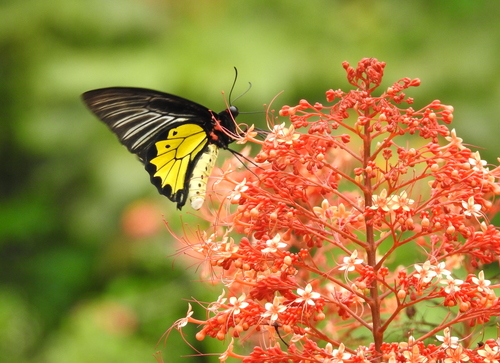
This entry describes the butterfly species Troides minos (Cramer, 1779), based primarily on a 1907 description from Charles Thomas Bingham in *The Fauna of British India, Including Ceylon and Burma, Butterflies Volume II*. Bingham notes that Troides minos differs from the related subspecies Troides helena cerberus in the following traits for males and females. For males: on the hindwing, the black coloring along the dorsal and terminal margins (on both the upper and undersides) is much broader. On the upperside of the hindwing, this black entirely fills interspace 1; on the underside, only a narrow yellow streak remains at the angle between the median vein and vein 2. The cone-shaped black markings on the terminal margin are shorter and broader than in T. h. cerberus. Black along the costal margin is narrower than in cerberus, barely extending below vein 8 except at the base and apex of the wing where it broadens. The abdomen is dull yellow both above and below, with no black shading. For females: the black coloring on the hindwing costal margin matches that of T. h. cerberus, but there is always a large yellow spot at the base of interspace 7. Interspace 1 is black, with a pale patch in the middle. The black terminal border is broader, and the inwardly extending cone-shaped markings are prominent. The markings in interspaces 2 and 3 have pale buff lateral edgings, which extend inwards to the postdiscal spots. In both males and females, the dorsal area of the hindwing upperside, from the base outwards, is covered in long, soft, silky brownish-black hairs. Adult wingspan ranges from 140 to 190 mm. This species is distributed across the Western Ghats and parts of the Eastern Ghats in Southern India, ranging from Bombay to Travancore. In the Western Ghats, it can be found at elevations up to 3000 feet (910 m), and occupies diverse habitats ranging from coastal lowland evergreen forests to mixed deciduous forests, dry scrub, and agricultural fields. Adults fly year-round, but are most abundant during and after the monsoon. The larva is roughly cylindrical, tapering slightly towards both ends. It has two rows of forward-curved fleshy processes, plus a double row of much shorter processes on each side. An extra long pair of processes sits between the dorsal and lateral rows on the 2nd, 3rd and 4th segments. The head is smooth and black; the body is a uniform dark madder brown, with a delicate pink tinge at the tips of some fleshy processes. The dorsal process on the 8th segment and a lateral pair on the 7th segment are pinkish-white, connected by a band of the same pinkish-white color. The pupa is suspended by the tail and a silk girdle that encircles it much closer to the head than is typical for Papilio pupae. It is stout and flattened, widened in the middle, with the head and thorax curved backwards. The head is somewhat angular and covered in tubercles; two abdominal segments each bear a prominent dorsal pair of pointed tubercles. Most pupae are light brown, with a distinctly contrasting old gold saddle-shaped marking, per observations from Davidson & Aitken. Multiple observers have noted that the pupa can produce an audible noise when touched. In 1875, Mr T. A. Sealy described the noise as a loud curious sound like "pha-pha!", which accompanies a short contraction of the abdominal segments. Sealy originally suspected the sound came from friction between adjacent pupa case rings, but noted the noise did not match a typical frictional sound, instead resembling air rushing through small holes. He was unable to produce the sound with a dead chrysalis, and observed that touched pupae sometimes contract without making noise, and require time to recover their vigour before producing sound again. Davidson and Aitken also observed this ability, describing the sound as a husky squeaking noise that is apparently produced by friction between abdominal rings. The larval host plants of Troides minos are small creepers and climbers from the family Aristolochiaceae, including Aristolochia indica, Aristolochia tagala, Thottea siliquosa, and Bragantia wallichii. Larvae sequester toxins from these host plants, which make adult butterflies unpalatable to predators. The species' bright coloration and slow flight advertise this unpalatability.