About Troides aeacus (Felder & Felder, 1860)
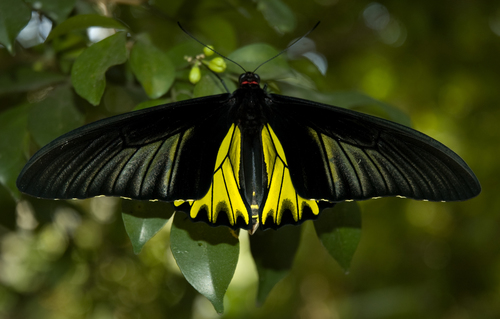
Troides aeacus, commonly known as the golden birdwing, has a wingspan that typically ranges from 150 to 170 millimetres (5.9 to 6.7 inches), and can reach up to 194 mm in the largest individuals. In males, the forewings are black with veins bordered by whitish color, while the hindwings are bright yellow. The underside of the wings is quite similar to the upperside. Females are larger than males, and their wings are dark-brown or black. The head, thorax, and abdomen of this butterfly are mainly black, with small red patches on the thorax and a yellow underside to the abdomen. Caterpillars are pale brown, with long protrusions that resemble thorns. They feed primarily on Aristolochia and Thottea species in the family Aristolochiaceae. Troides aeacus closely resembles the subspecies Troides helena cerebrus, and differs from it in the following ways. For male T. aeacus: On the upperside forewing, the pale streaks along the veins (adnervular streaks) are more prominent, and in some specimens these streaks extend into the cell along the outer half of the subcostal and median nervules. On the upperside hindwing, the cone-shaped terminal black markings in interspaces 2, 3, and 4 have a more or less broad dusky area irrorated with blackish scales on their inner side; the black coloring on the costal margin is narrower, and does not extend below vein 8. The underside of the wings is similar to the upperside, but the dusky black borders to the cone-shaped marks in interspaces 2, 3, and 4 are absent. Antennae, head, thorax, abdomen, and abdominal fold match the features of Troides helena cerebrus, but the underside of the abdomen has two rows of black spots. For female T. aeacus, differences from T. helena cerebrus include: on the forewing, pale adnervular streaks are very broad, very prominent, and extend well into the cell; on the hindwing, the basal third of the cell and interspace 2 is black, the middle portion of interspace 2 is yellow on the anterior side and buffy-white on the posterior side, the posterior half of the discal area between the postdiscal spots themselves, and between these spots and the terminal cone-shaped markings, is more or less irrorated with blackish scales, and finally, the black marking in interspace 7 is interrupted by an inner triangular yellow spot and an outer small yellow spot. Antennae, head, thorax, and abdomen match T. helena cerebrus, but the underside of the abdomen has two lateral and two median rows of black spots. This species is distributed across northern India, Bangladesh, Nepal, Bhutan, Burma, China, Thailand, Laos, Vietnam, Cambodia, peninsular Malaysia, and Taiwan. Although Troides aeacus is classified as a species of Least Concern on the IUCN Red List, it may require protection within peninsular Malaya.