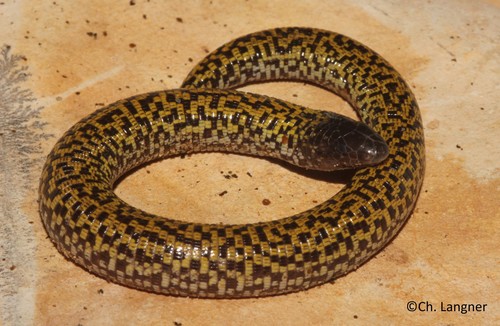
About Trogonophis wiegmanni Kaup, 1830
Both subspecies of Trogonophis wiegmanni share the following morphological characteristics. The head is rounded and slightly compressed dorsoventrally, with a slightly protruding snout. Two pairs of cephalic shields are present, nostrils open forward, and external ears are absent. Compared to other members of the family Trogonophidae, this species has an elongate skull. Its body is wormlike: it is legless, elongate, cylindrical, and annulated, with sunken lateral lines. The short, conical tail does not have the ability to autotomize (self-amputate). Relative to other legless lizards, the body of T. wiegmanni is short and stout, and neither sex has pre-anal pores. T. wiegmanni occurs in areas with abundant leaf litter, sandy moist soil covered by stones and other ground cover. It can also be found near roadsides, in traditionally cultivated areas, in oak forest and oak-juniper forests, in non-vegetated sandy patches, and in steppe habitat. This species tolerates a broad range of habitat types, including temperate forest, shrubland, temperate grassland, artificial terrestrial arable land, and artificial terrestrial pastureland. It has been recorded at elevations ranging from sea level up to 1,900 m (6,200 ft). The native geographic range of T. wiegmanni covers northern Algeria, western Morocco, the Chafarinas Islands belonging to Spain, and northwestern Tunisia. T. wiegmanni is a viviparous species.

