About Trogon surrucura Vieillot, 1817
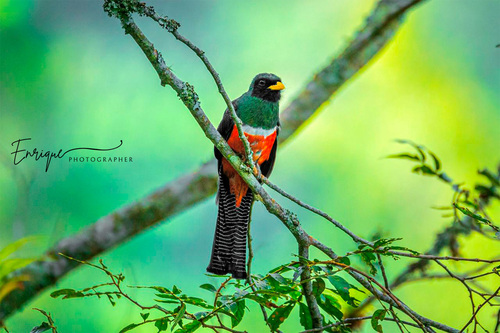
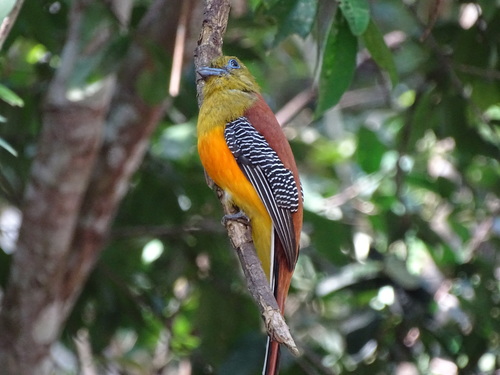
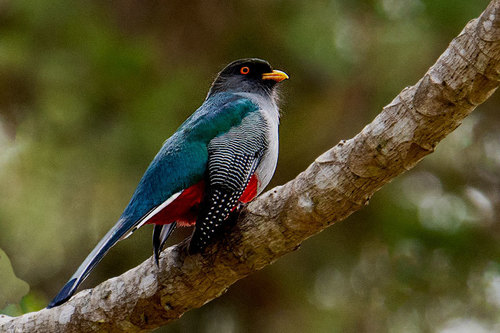
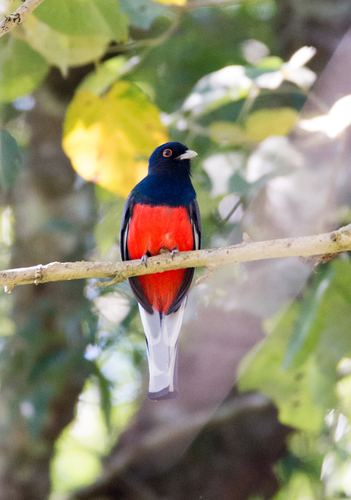
This species, Trogon surrucura Vieillot, 1817, has two recognized subspecies. The nominate subspecies, T. s. surrucura, measures 26 to 28 cm (10 to 11 in) in length and weighs 56.3 to 78 g (2.0 to 2.8 oz). Males of the nominate subspecies have a blackish face and throat, with an orange ring surrounding the eye. Their crown, neck, and breast are royal blue, their back is coppery green that shifts to turquoise-green on the upper surface of the tail. The folded wing has fine vermiculation that appears gray from a distance. The belly is pinkish red, the flanks are gray, and the underside of the tail is white with a black bar across its tip. Nominate females are mostly gray, with the red belly color starting lower on the body. Instead of an orange eye ring, they have small white spots before and after the eye, and the underside of their tail has a black and white pattern. The second subspecies, T. s. aurantius, is about 28 cm (11 in) long. Males of T. s. aurantius differ from the nominate subspecies by having a yellow eye ring and an orange belly. Females of this subspecies have a yellowish white to orange-yellow belly. For distribution and habitat, the nominate subspecies of Surucua trogon ranges from eastern Paraguay and northeastern Argentina east into Uruguay, and in Brazil it extends as far north as southeastern Tocantins. T. s. aurantius has a smaller restricted range in east central and eastern Brazil, from Bahia south to São Paulo state. Both subspecies live in the mid levels of primary forest, well-developed secondary forest, and semideciduous woodland. T. s. aurantius is often found associated with bamboo. The nominate T. s. surrucura occurs at elevations up to 1,150 m (3,800 ft) in Bahia, up to 1,550 m (5,100 ft) in Minas Gerais, and reaches even higher elevations in Rio de Janeiro state. T. s. aurantius occurs at elevations up to approximately 2,000 m (6,600 ft).