About Trogon rufus tenellus Cabanis, 1862
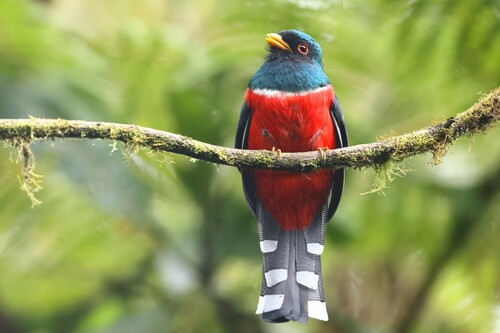
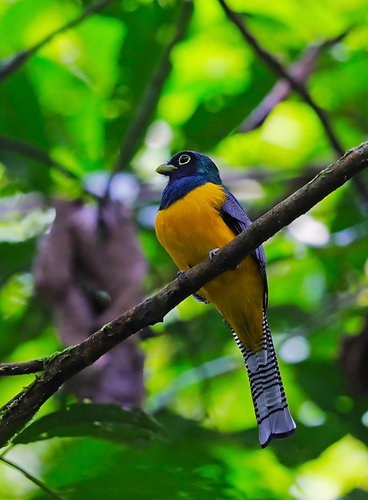
Like most trogons, the Amazonian black-throated trogon has distinctively different plumage for males and females, with soft, colorful feathers. This is a relatively small species, measuring 24 to 26 cm (9.4 to 10 in) in length and weighing 45 to 60 g (1.6 to 2.1 oz).
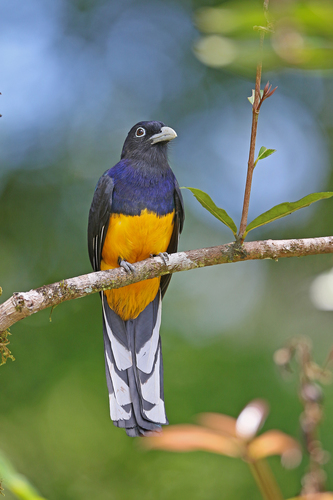
Adult males of the nominate subspecies T. r. rufus have a black forehead and face, with a pale blue ring of bare skin surrounding the eye. Their crown, back, lesser wing coverts, rump, and uppertail coverts range from metallic green to blue. Their flight feathers, primary coverts, and secondary coverts show various black and white patterns. The upper side of the tail is metallic green to blue with a black band at the tip. The underside of the tail has narrow black bars and medium-width white bars. Their chin and throat are black, their upper breast is metallic green to blue, and their lower breast and belly are yellow; a thin white band below the upper breast is present in some individuals.
Adult females have mostly brown upperparts, with a darker crown and lighter rump and uppertail coverts. Their face is brown, with a pale blue ring of bare skin around the eye. Their primaries are mostly fuscous-black, with a narrow white edge along their outer webs. Their secondaries, and greater and median wing coverts are copper-colored with a dusky tinge. Their lesser wing coverts are black with brown tips. The upper side of the tail is mostly dark reddish brown with a wide black band at the tip. The underside of the tail has narrow black and white bars. Their throat and upper breast are a paler brown than their back, with a white band below the upper breast. Their lower breast and belly are yellow.
Immature birds resemble adults but have duller plumage. Young males have brown throat, breast, and wing coverts. Males have a mostly bright yellow to yellow-green bill. Females have highly variable bill color, ranging from black with some yellow to dusky yellow with some black. Nestlings and juveniles have a mostly black bill. All ages of both sexes have a dark brown iris. Adults have bluish gray legs and feet; the legs and feet of nestlings and juveniles may be pinkish.
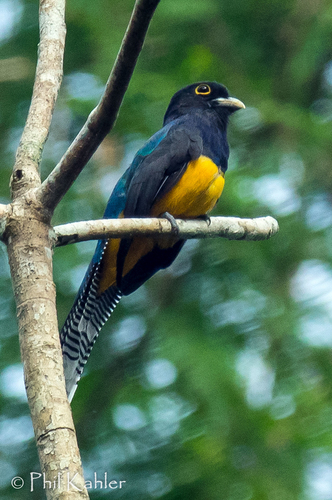
Both sexes of the subspecies T. r. sulphureus are larger than the nominate subspecies. Males have a yellow or yellow-green eye ring and a golden-green rump. The upper side of their tail is mostly reddish copper with a black band at the end and a green band between the reddish copper and black. Both the black and white bars on the underside of the tail are wider than those of the nominate. Usually, they have little to no white on their breast. Females have a green or yellow-green eye ring, and the black band on the upper side of their tail is narrower than that of the nominate. Both the black and white bars on the underside of their tail are wider than those of the nominate.
Males of the subspecies T. r. amazonicus have a yellow or yellow-green eye ring, a golden-green rump, and a golden-green chest. The upper side of their tail is mostly reddish copper to shiny olive-green with a black band at the end and a green band between the other colors. The black bars on the underside of the tail are narrow, and the white bars are medium width. Usually, they have little to no white on their breast. Females have a yellow eye ring. The upper side of their tail is dark reddish brown to very dark brown with a narrow black band at the end. Both the black and white bars on the underside of the tail are narrow.
The ranges of the Amazonian black-throated trogon subspecies are as follows. T. r. rufus is found from eastern Venezuela east through the Guianas and northern Brazil to the Atlantic coast. T. r. sulphureus occurs from east-central and southeastern Colombia south through eastern Ecuador into northeastern Peru, and east into southern Venezuela, western Brazil, and far northern Bolivia. T. r. amazonicus is found in southern Venezuela and northeastern Brazil. T. r. sulphureus and T. r. amazonicus intergrade along the Madeira River, while T. r. rufus and T. r. amazonicus intergrade along the Amazon.
The Amazonian black-throated trogon generally lives in the understory to mid-story of humid primary forest interiors and mature secondary forest, and it favors areas near streams. In Colombia, it occurs in terra firme forest. In southwestern Brazil, it is sometimes associated with stands of Guadua bamboo. The maximum elevation it reaches varies by region: 1,400 m (4,600 ft) in Colombia, 700 m (2,300 ft) in Ecuador, 650 m (2,100 ft) in Peru, 900 m (3,000 ft) in Venezuela, and only about 300 m (1,000 ft) in Bolivia.