About Trogon melanurus Swainson, 1838
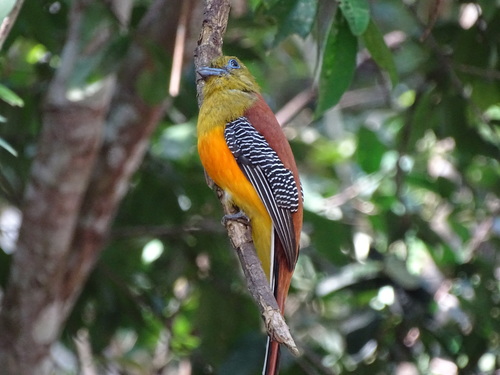
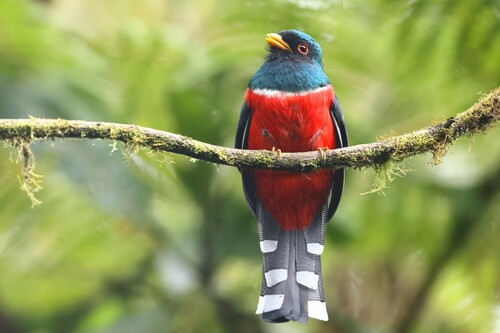
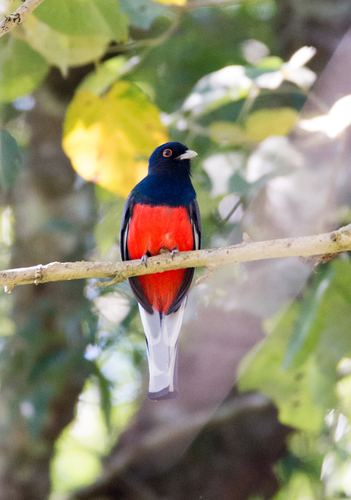
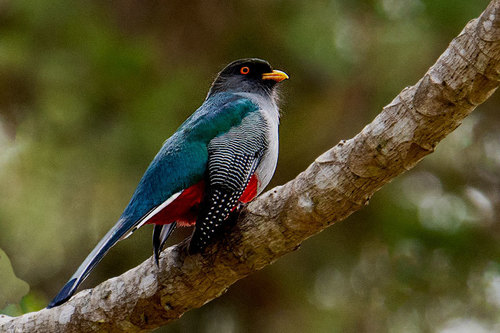
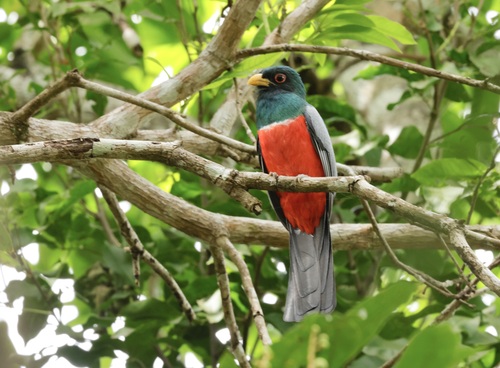
Black-tailed trogon (Trogon melanurus Swainson, 1838) measures 28 to 30 cm (11 to 12 in) in length and weighs 52 to 122 g (1.8 to 4.3 oz). The male of the nominate subspecies has a yellow bill, a blackish face and throat, and an orange-red ring around the eye. Its crown, nape, upperparts, and breast are green, with a white band separating the breast from the red belly and vent. The upperside of its tail is deep blue, and the underside is slaty gray. The folded wing has fine vermiculation that appears gray from a distance. The female has a slaty maxilla; she is gray in all areas where the nominate male is green, and the gray of her breast extends further into the upper belly. Instead of an orange-red eye ring, she has white arcs before and after the eye. Male T. m. macroura have coarser wing vermiculation than the nominate subspecies, more turquoise upper tail color, and longer wings and tail. Male T. m. eumorphus are similar to the nominate subspecies, but have darker wings, a bluer tail, and a narrower white breast band. T. m. occidentalis cannot be distinguished from T. m. eumorphus. The range of T. m. macroura is separate from that of the other subspecies; it occurs in Panama east of the Canal Zone, through northern Colombia, and into extreme northwestern Venezuela. The nominate subspecies T. m. melanurus is found from eastern Colombia through southern Venezuela and the Guianas, and extends south into northeastern Brazil as far as Maranhão state. T. m. eumorphus is found south of the range of T. m. melanurus, ranging from southern Colombia through eastern Ecuador and Peru into northern Bolivia, and east into Amazonian Brazil. When treated as a separate subspecies, T. m. occidentalis is said to occur in the São Paulo region of southeastern Brazil, but this area does not appear on published range maps for the black-tailed trogon. Across its large range, the black-tailed trogon lives in different landscapes. In Panama, it occurs in the interior and edges of humid lowland and foothill forests, including both primary and secondary forest. In Venezuela and French Guiana, it inhabits rainforest. In Amazonia, it lives in several forest types, including transitional forest, swamp forest, gallery forest, terra firme forest, and várzea forest. In Colombia west of the Andes, it can be found as high as 2,200 m (7,200 ft), though it mostly occurs at much lower elevations; east of the Andes, it reaches only 500 m (1,600 ft). In Venezuela north of the Orinoco River, it is found only below 100 m (330 ft), while south of the river it ranges up to 1,000 m (3,300 ft).