About Trogon melanocephalus Gould, 1836
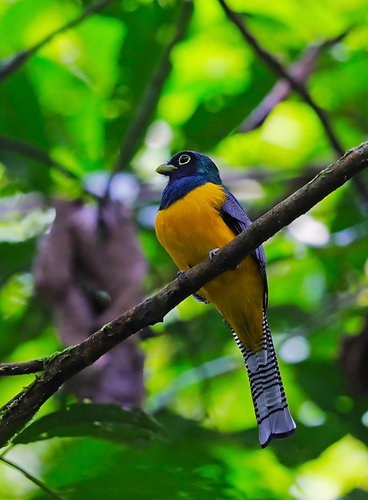
The black-headed trogon (Trogon melanocephalus Gould, 1836) is 27 to 28 cm (11 to 11 in) long and weighs approximately 74 to 95 g (2.6 to 3.4 oz). Adult individuals of both sexes have a slate-black to black head, neck, and chest. A ring of bare sky-blue skin surrounds the dark eye. A thin white line divides the chest from the rest of the underparts, which are colored cadmium to chrome yellow and lighten at the vent area. The two innermost pairs of tail feathers are metallic bronze green to bluish green with black tips. The next pair is entirely black, and the outermost three pairs are black with wide white tips. The wings are slate black with some white markings. Adult males have bright metallic bluish green to golden green upperparts, with metallic blue to bluish violet rump and uppertail coverts. Adult females have dark slate upperparts, in place of the male's metallic upperparts. Immature males have a mostly black tail with only a limited amount of white, and their wings have more white than the wings of adult black-headed trogons. Immature females lack black tips on their inner tail feathers, and like immature males, they also have less white on the tail than adults. The black-headed trogon is distributed on the Caribbean slope from southern Veracruz in Mexico, south through Belize, northern Guatemala, and northern Honduras to central Nicaragua. It is also found on the Pacific slope from El Salvador through southern Honduras and western Nicaragua into northwestern Costa Rica. This species lives in a range of forest types, including wet and moist tropical forest, pinelands, gallery forest, secondary forest, and dry forest. It prefers forest edges over dense forest interiors, and also occurs in other semi-open to open landscapes such as banana and cacao plantations, gardens, and suburban areas. It usually occurs at elevations between sea level and 600 m (2,000 ft), though it can be found as high as 1,000 m (3,300 ft).