About Trogon collaris Vieillot, 1817
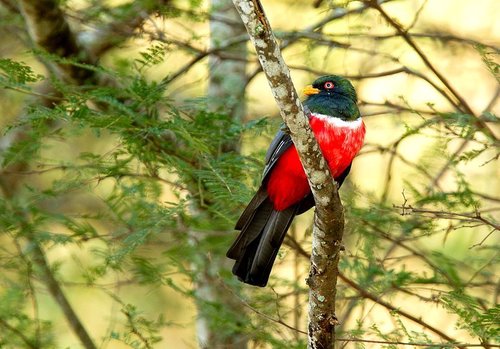
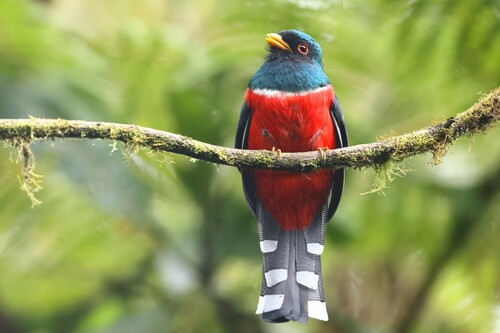
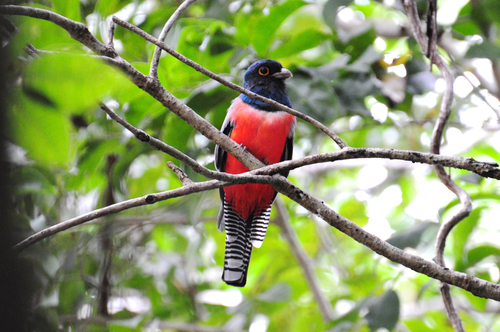
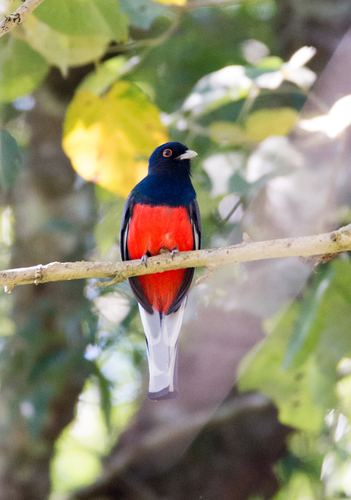
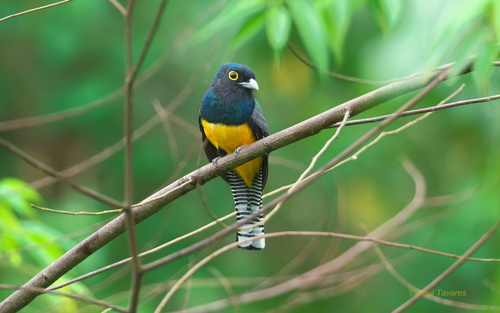
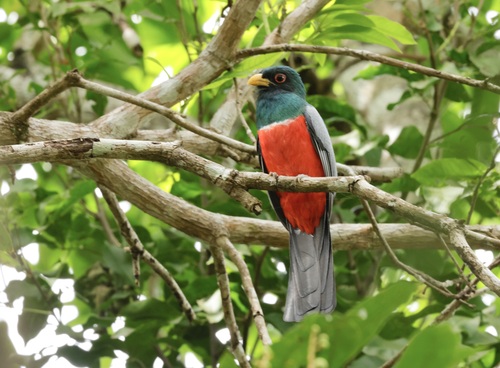
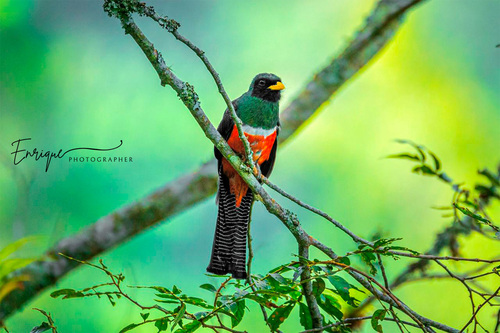
Trogon collaris Vieillot, 1817, commonly called the collared trogon, is a member of the trogon family, a group in which males and females have distinctively different plumages, with soft, often colorful feathers. The collared trogon measures about 25 to 29 cm (9.8 to 11.4 in) in length and weighs approximately 41 to 64 g (1.4 to 2.3 oz). Both sexes share a black face and throat. Males have bright metallic green plumage on the crown, nape, back, and rump; their folded wings show black and white vermiculation. The male's breast is also metallic green, with a white band that separates it from the bright red belly and vent. The upperside of the male's tail is green with a black tip, while the underside is barred black and white. In areas where the male is green, the female has olive brown plumage; the female's closed wing is brown with black vermiculation, and her belly is a duller red than the male's. The underside of the female's tail is gray with a few black bars and white tips. There are 10 recognized subspecies of collared trogon, with the following distributions: T. c. puella is found from central Mexico to western Panama; T. c. underwoodi is found in northwestern Costa Rica; T. c. aurantiiventris is found from central Costa Rica to western Panama; T. c. extimus is found in eastern Darién Province in northeastern Panama; T. c. heothinus is found in Panama's Serranía del Darién; T. c. virginalis is found from western Colombia through western Ecuador into northwestern Peru; T. c. subtropicalis is found in central Colombia, especially the Magdalena and Cauca valleys; T. c. exoptatus is found in northern Venezuela, with an uncertain presence in Trinidad & Tobago; T. c. collaris is found east of the Andes from Colombia south to northern Bolivia, and east through the Guianas and much of west central Brazil, with an uncertain presence in Trinidad & Tobago; T. c. castaneus is found from southeastern Colombia south to eastern Peru and northern Bolivia and into northwestern Brazil, and also in eastern Brazil. Taxonomic authorities disagree on which subspecies occurs in Trinidad & Tobago: Clements places T. c. exoptatus there, while the IOC places T. c. collaris there instead. In South America, the collared trogon lives in humid lowland evergreen forest, including both primary forest and well-established secondary forest. In Mexico and Central America, it inhabits these same forest types, and also lives in humid montane forest, semideciduous forest, and pine-evergreen forest. It occurs at elevations up to 2,400 m (7,870 ft) in Mexico and up to 2,300 m (7,550 ft) in Costa Rica, but in the Andes it is found mostly below 1,300 m (4,270 ft) in Ecuador and below 1,200 m (3,940 ft) in Peru.