About Trogon citreolus Gould, 1835
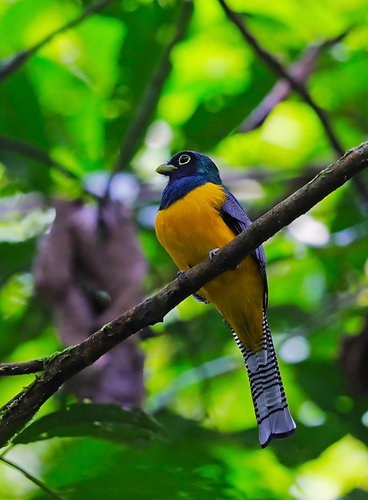
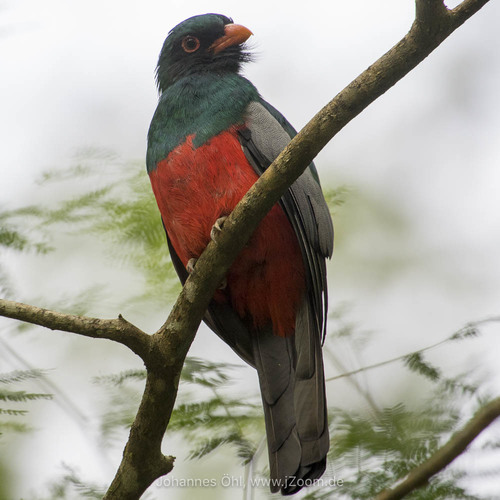
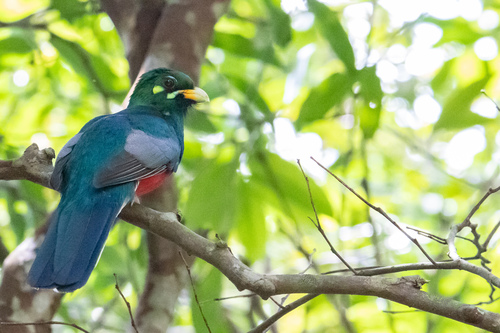
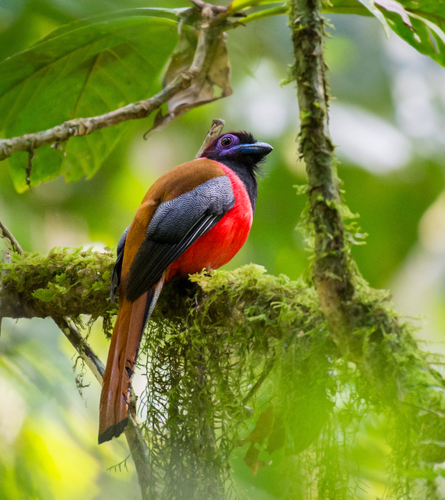
This species measures around 27 cm in length and weighs between 85 and 90 grams. Adult males have a uniform gray head and upper breast, along with a metallic green mantle that fades to a violet-blue rump. Their bill is pale blue-grey, and their eyes are yellow. The uppertail is blue-green with a black tip, and the wings are dark, with white outer webs on the primaries. A creamy white breastband separates the dark gray upper breast from the bright yellow belly and undertail. Females are entirely dark gray on their upperparts, and typically have a paler gray breast and paler yellow belly. Both sexes have dark bills, yellow eyes, and predominantly white undertails. Near Ocozocoautla de Espinosa, this species (the citreoline trogon) can overlap in range with the black-headed trogon. In this area, the citreoline trogon is paler overall, has more white on the undertail (this white extends all the way to the undertail coverts on the outer webs), and lacks the dark eye and white eyering seen in the black-headed trogon. Its voice is similar to that of Trogon melanocephalus: a rapid sequence of low, throaty, short notes that resembles the call of an antbird. During the mating season, multiple individuals of each sex gather close together on scattered trees. Skutch observed the following courting behavior: "As each calls, it jerks its tail up and down with rapid but mincing strokes and shakes its slightly relaxed wings. Occasionally one trogon darts at another, who usually retreats without any show of resistance. The birds are evidently courting, but the proceedings are so long drawn out that it requires extraordinary patience to follow them to their natural conclusion. Later, while carving out the nest cavity, the trogons give voice to low, whining notes which resemble the grunts of new-born puppies." Its natural habitats include arid or semi-arid woodland, low coastal jungle, thorny brushland, thorn-forest, mangroves, and plantations. This species builds its nest in cavities inside arboreal termitaria, which are termite nests built in trees. It is thought that this nesting behavior plays a critical role in creating necessary cavities for many other organisms that live in tropical dry forests. Trogon citreolus reproduces between May and August. It nests in arboreal termite nests located in relatively sheltered vegetation, and each nest contains 2 to 4 eggs.