About Troglodytes troglodytes (Linnaeus, 1758)
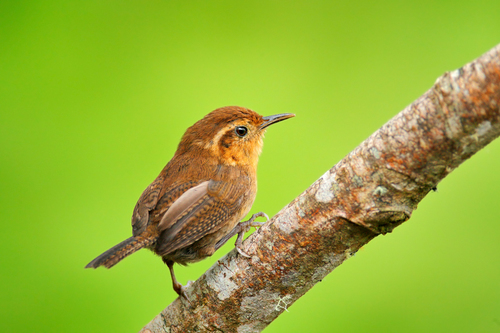
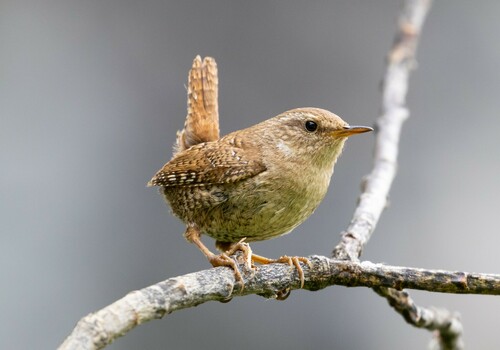
The Eurasian wren, scientifically named Troglodytes troglodytes (Linnaeus, 1758), is a plump, sturdy bird with rounded wings and a short tail that is usually held cocked upright. Adults measure 9 to 10 cm (3.5 to 3.9 in) in length, have a wingspan of 13–17 cm (5.1–6.7 in), and weigh approximately 10 g (0.35 oz). Its upperparts are rufous brown, while its underparts are greyer. Its body, wings, and tail all have indistinct darker brown and grey barring. It has a dark brown bill, pale brown legs, feet with strong claws and a large hind toe. Young birds have less distinct barring and mottled underparts. Plumage varies considerably across the species; in isolated populations, this variation has become fixed in one minor form or another. The Eurasian wren is a Palearctic species. The nominate race breeds in Europe as far north as 67°N in Norway and 64°N in Sweden, Finland, and Russia. Its southern breeding limit reaches northern Spain, southern France, Italy, Sicily, and southern Russia, and it also breeds in Western Asia as far east as Syria. Other races replace the nominate race in Iceland, the Faroe Islands, Shetland, the Hebrides, and St Kilda; further south in northwestern Africa, Spain and Portugal, the Balearic Islands, Corsica, Sardinia, Crete, and Cyprus; and additional races live in southern Russia and Japan. This wren uses a very wide range of habitats. It typically occupies any cultivated or uncultivated area with bushes and low ground cover, including gardens, hedgerows, thickets, plantations, woodland, and reed beds. It also lives in more open locations with bramble or gorse clumps, rough pasture, moorland, boulder-strewn slopes, rocky coasts, and sea cliffs. The Eurasian wren is constantly active, continuously moving while foraging for insects either in the open or among thick vegetation. It moves in quick jerks, probing into crevices, examining old masonry, hopping onto fallen logs, and delving among them. It sometimes moves higher into tree canopies, but mostly stays close to the ground and is often flushed out from under overhangs on banks. It occasionally hops up the lower sections of tree trunks, acting like a miniature nuthatch. It sometimes flits away; its short flights are swift and direct but not sustained, and its tiny round wings whirr during flight. This small, short-tailed wren is almost as well-known across Europe as the robin. It moves in a mouse-like way and is easy to lose sight of while it hunts for food, but occurs everywhere from the tops of the highest moors down to the sea coast. It remains in upland areas even through winter, vanishing into heather when thick snow covers the ground, living up to its scientific identity as a troglodyte. It visits gardens and farms, and is just as abundant in thick woods and reed beds. At night, most often during winter, it often roosts in dark secluded spots, snug holes, and even old nests, matching the meaning of its scientific name. In harsh weather, multiple wrens may roost together, either as a family group or a gathering of many individuals, to retain warmth. Insects make up most of the Eurasian wren's diet, primarily larvae of butterflies and moths (including geometer moths and owlet moths), plus beetle larvae, fly larvae, caddisfly larvae, and aphids. It also eats spiders and some seeds. Young wrens are fed mostly on moth larvae, with recorded items including cabbage moth caterpillars and crane fly larvae.