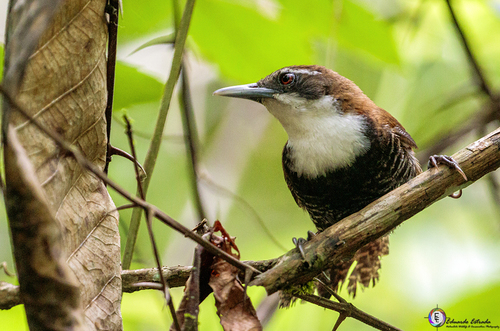
About Troglodytes rufociliatus Sharpe, 1882
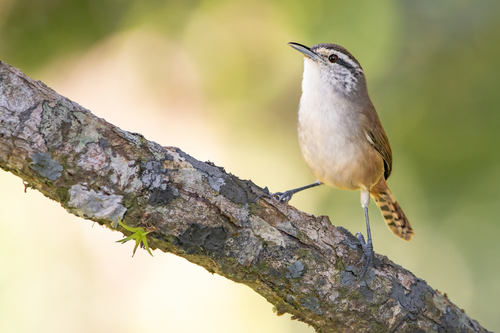
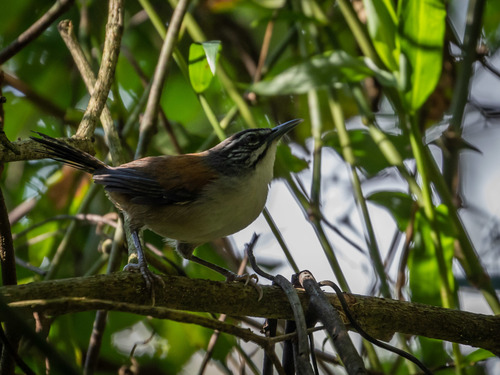
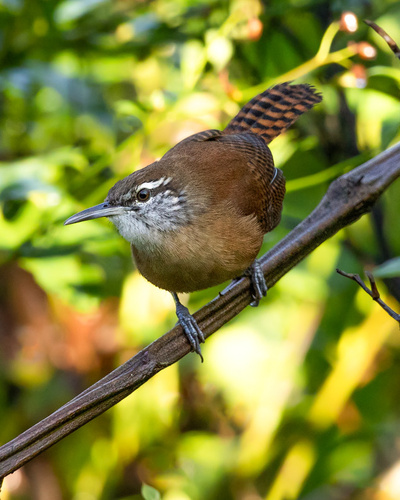
The rufous-browed wren (Troglodytes rufociliatus Sharpe, 1882) measures 10 to 11.5 cm (3.9 to 4.5 in) long and weighs approximately 11 g (0.39 oz). For the nominate subspecies, adult individuals of both sexes have dark brown crowns, backs, and rumps, with warm brown tails that, along with the back, are marked with dark bars. They have a pale buff supercilium, darker brown cheeks, a buffy chin, and yellowish buff throat and chest that darkens toward the sides. The lower belly and vent area are barred. Four subspecies are recognized, each with distinct differences from the nominate. T. r. chiapensis is darker on the upperparts, has a rufous cast to the throat, and a white belly. T. r. nannoides has a darker back and heavier barring on the flanks. T. r. rehni is more reddish brown on the upperparts and has a more yellowish throat. Each subspecies also has a separate geographic distribution. T. r. chiapensis, the most northerly subspecies, lives in the mountains of Chiapas, southern Mexico. The nominate subspecies T. r. rufociliatus occurs in central and southern Guatemala and northern El Salvador. T. r. nannoides is found only on Santa Ana Volcano in western El Salvador. T. r. rehni occurs in Honduras and northwestern Nicaragua. This wren lives in multiple types of humid montane forest. Its elevation range in Guatemala is 1,700 to 3,500 m (5,600 to 11,500 ft), and it has been recorded as low as 1,250 m (4,100 ft) in Nicaragua.