About Troglodytes ochraceus Ridgway, 1882
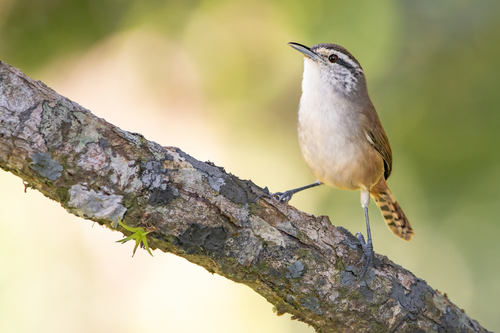
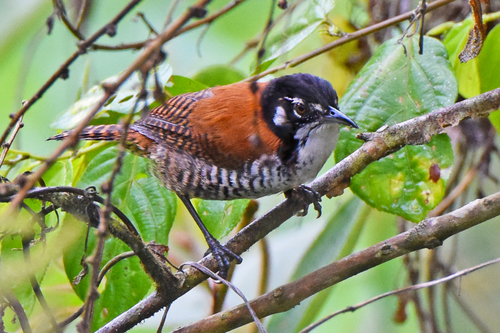
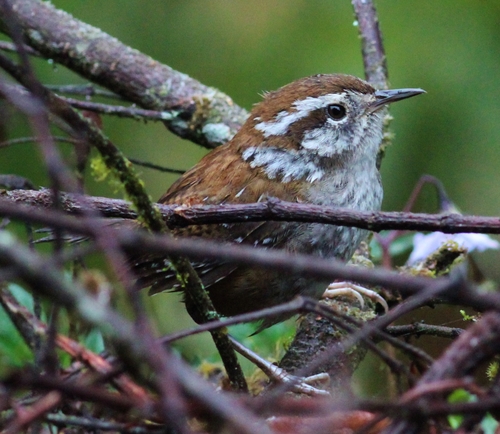
Troglodytes ochraceus, commonly known as the ochraceous wren, was formally described by Ridgway in 1882. Adult ochraceous wrens measure 9.5 to 10 cm (3.7 to 3.9 in) in length and weigh 8 to 10 g (0.28 to 0.35 oz). The strictly defined nominate subspecies has a rich medium brown crown and back, with a rufous tint on the rump. Its tail is brown with blackish bars, and it has a prominent yellowish buff supercilium that extends all the way to the nape. The bird's chin, throat, and upper chest are buffy brown; its lower breast and upper belly are buffy white; and its flanks and lower belly are a darker buffy brown. When treated as a separate subspecies, T. o. ligea is duller than the nominate and has a heavier bill. T. o. festinus is smaller than the nominate, has lighter underparts, and also has a larger bill than the nominate. Different taxonomic authorities differ in their classification of the species' subspecies distributions. According to the International Ornithological Congress (IOC), the nominate subspecies is found in the highlands of Costa Rica from the Tilarán Mountains to the Talamanca ranges, and also in western and central Panama. Cornell and Clements classify the Panamanian population as T. o. ligea, and restrict the range of T. o. ochraceus to Costa Rica. All three authorities place T. o. festinus in eastern Panama. Cornell, Clements, and the South American Classification Committee of the American Ornithological Society (SACC/AOS) also note that T. o. festinus occurs in adjacent northwestern Colombia. The ochraceous wren primarily lives in wet montane forest that is rich in epiphytes. It also inhabits semi-open areas including woodland edges, tall second growth, and pastures with scattered trees. It usually occurs at elevations between 900 and 2,450 m (2,950 and 8,040 ft), though it has occasionally been recorded as low as 600 m (2,000 ft) and as high as 3,000 m (9,800 ft).