About Troglodytes hiemalis Vieillot, 1819
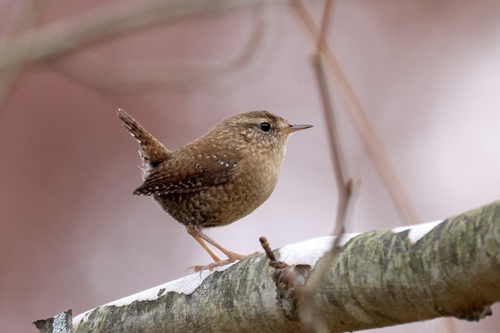
This species, Troglodytes hiemalis, commonly called the winter wren, has a small tail that is often held cocked above its back. A short neck gives it the overall look of a tiny brown ball. It is rufous brown on its upper body, grayer on its lower body, and has darker brown and gray barring across its body, wings, and tail. It has a dark brown bill and pale brown legs. Young birds have less distinct barring than adults. Most individuals can be recognized by the pale eyebrow stripe above their eyes. Measured dimensions are: length 3.1–4.7 in (7.9–11.9 cm), weight 0.3–0.4 oz (8.5–11.3 g), and wingspan 4.7–6.3 in (12–16 cm). Winter wrens nest mostly in coniferous forests, particularly spruce and fir forests, where they are often detected by their long, exuberant song. Though they are insectivores, they can stay in moderately cold, even snowy climates by foraging for insects on substrates like bark and fallen logs. Their creeping and climbing movements are constant rather than fast. Their short flights are swift and direct, but not sustained; their tiny round wings whir as they fly between bushes. At night, usually during winter, they often roost in dark, snug retreats, holes, and even old abandoned nests, matching the meaning of their scientific name. In harsh weather, they may roost in groups, either as a single family or multiple unrelated individuals gathered together to share warmth. Winter wrens feed primarily on arthropods, and they prefer spiders, caterpillars, adult beetles, and flies. Less common food items include arthropods from the groups Acari (mites and ticks), Hymenoptera (bees, wasps, and ants), Chilopoda (centipedes), Diplopoda (millipedes), and Amphipoda (amphipods).