About Troglodytes aedon Vieillot, 1809
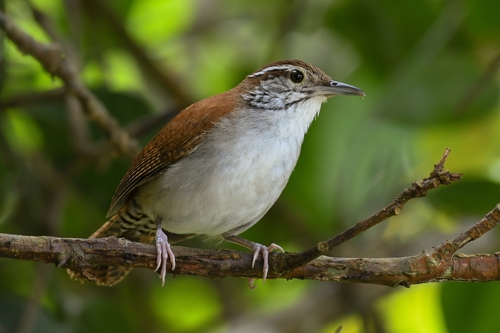
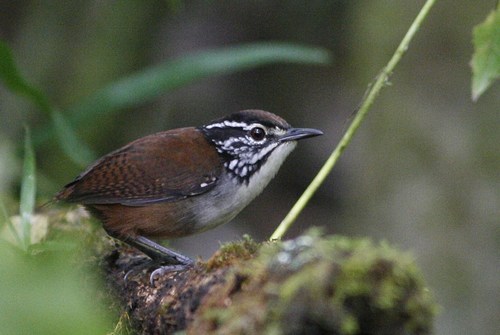
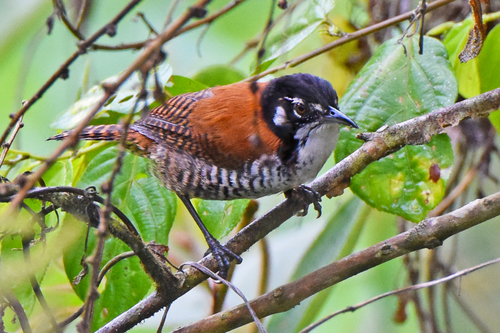
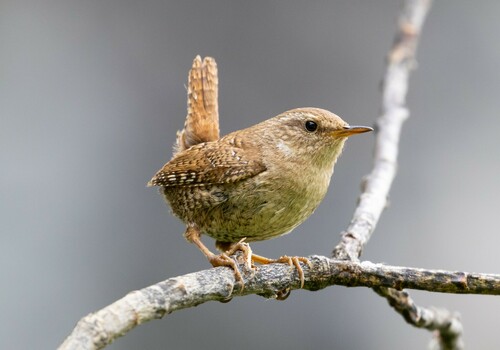
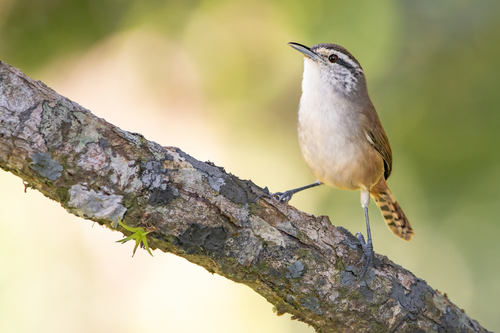
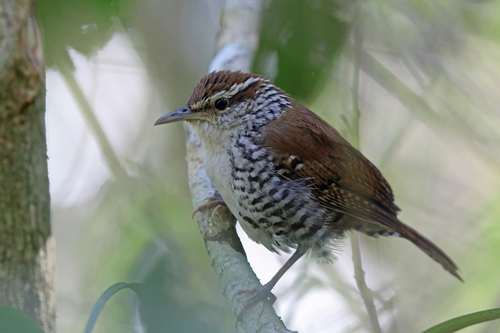
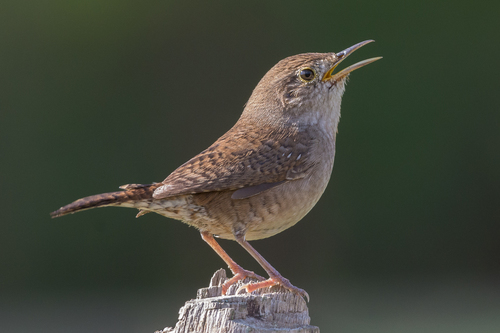
This species has the scientific name Troglodytes aedon Vieillot, 1809. Description: Adult northern house wrens measure approximately 11 to 13 cm (4.3 to 5.1 in) in length, with a 5.9 in (15 cm) wingspan, and a weight of around 10 to 12 g (0.35 to 0.42 oz). For standard body measurements: the wing chord is 4.7 to 5.3 cm (1.9 to 2.1 in), the tail is 3.9 to 4.4 cm (1.5 to 1.7 in), the culmen is 1.1 to 1.3 cm (0.43 to 0.51 in), and the tarsus is 1.6 to 1.8 cm (0.63 to 0.71 in). Different subspecies vary greatly in appearance: upper body plumage ranges from dull greyish-brown to rich rufescent-brown, while underpart plumage ranges from brown, through buff and pale grey, to pure white. All subspecies have blackish barring on the wings and tail; some subspecies also have this barring on the flanks. All subspecies display a faint eye-ring and eyebrow stripe, and have a long, thin bill. The upper mandible of the bill is blackish, while the lower mandible is yellowish or pale grey with a black tip. The legs of the bird are pinkish or grey. The short tail is typically held in a cocked position. This species' rich, bubbly song is commonly heard during the nesting season, but is rarely heard after this season. There is clear geographical variation in the species' song, though this variation is somewhat more gradual than variation in the species' outward appearance. Outward appearance can differ strikingly even between populations on neighboring islands in the Caribbean. Even so, birds from the far northern and far southern parts of the species' range have songs that differ markedly from one another. Behavior and ecology: Northern house wrens are thought to reach their highest population density in floodplain forests of the western Great Plains, where they use woodpecker holes as nesting sites. Northern populations of these birds migrate to the southern United States and Mexico for the winter. Most migrating individuals return to their breeding grounds between late April and May, and depart for their winter quarters around September to early October. These birds forage actively within vegetation. They mainly eat insects such as butterfly larvae, beetles, and true bugs, and also eat spiders and snails. Southern house wrens rarely join mixed-species feeding flocks.