About Trochus intextus Kiener, 1850
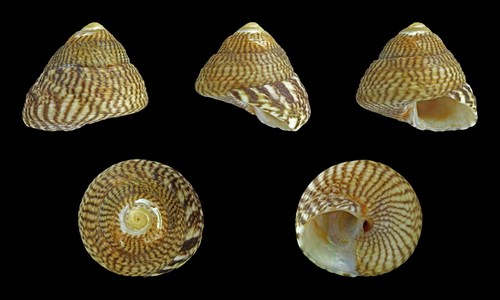
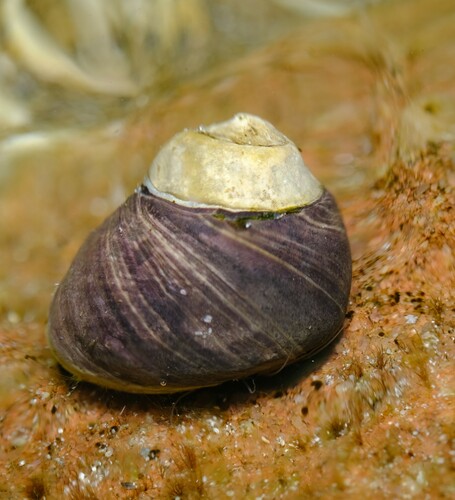
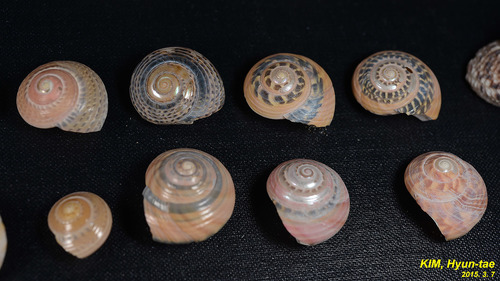
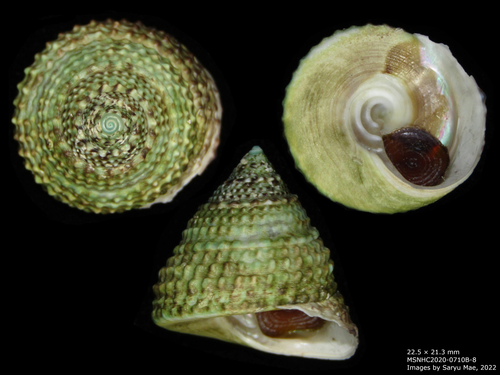
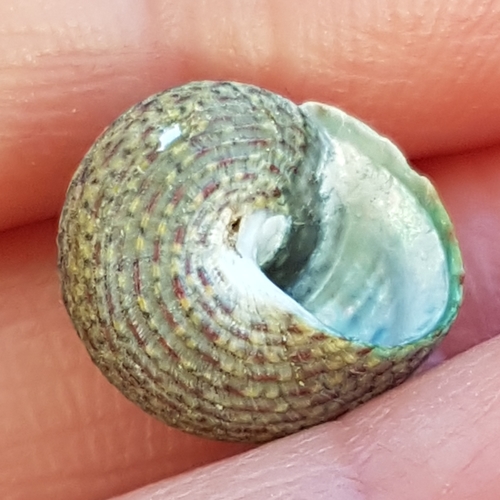
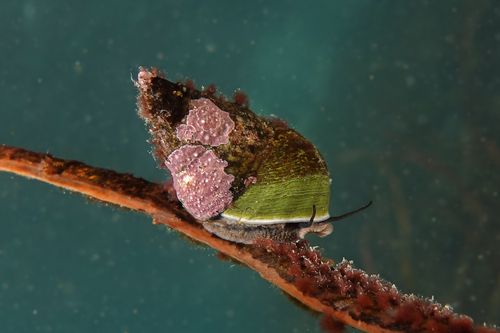
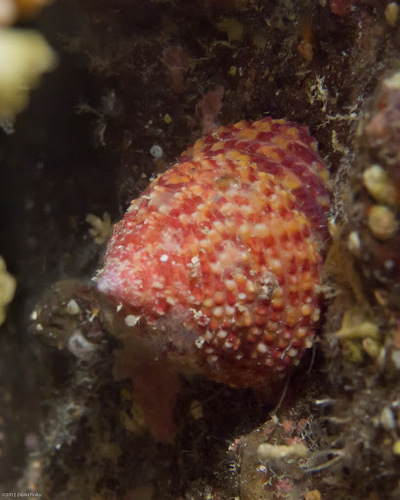
This marine species, Trochus intextus Kiener, 1850, has a shell that measures between 20 mm and 30 mm in size. The shell is thick, solid, and has a distinctly straight conical shape, and it is falsely umbilicate. The outlines of its nearly rectilinear spire are nearly straight, ending in an acute apex. The shell holds approximately eight whorls. The body whorl is obtusely angled at its periphery, and the sutures are barely impressed. The upper surface of the shell is grayish or corneous white, marked with broad longitudinal stripes of red or purplish; the red color may cover the entire shell surface, or may be reduced to small spots or narrow lines. The base of the shell has narrow, zigzag, radiating red stripes. The sculpture of the upper surface is made up of spiral rows of very regular, deeply separated rounded granules or beads, with five or six rows on each whorl. The granules are smaller on the periphery and base of the shell. On the shell base, the rows are more widely separated, and sometimes have tiny intercalated beaded lirae. In total, there are 12 to 15 rows of beads across the entire body whorl in the interstices. The aperture is small, with strong lirae inside the outer lip. The dentate basal margin is thick. The parietal wall is callous, strongly lirate, and colored deep crimson. The columella is oblique, and bears 3 or 4 irregular dentations. The umbilical tract has a heavy white callus on its inside, and is obsoletely spirally biplicate or triplicate. This marine species is found in the Western Pacific Ocean and in waters off Hawaii.