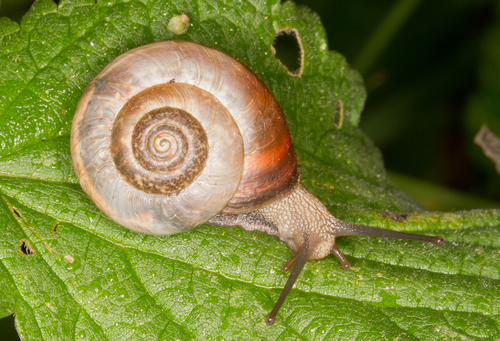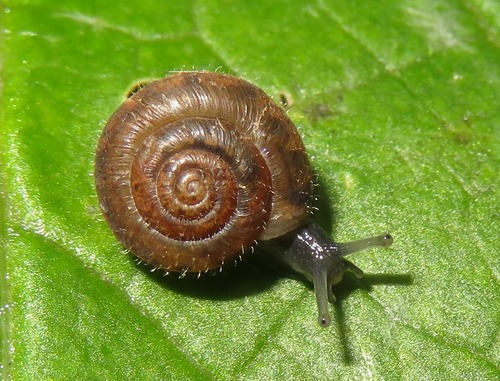
About Trochulus hispidus (Linnaeus, 1758)
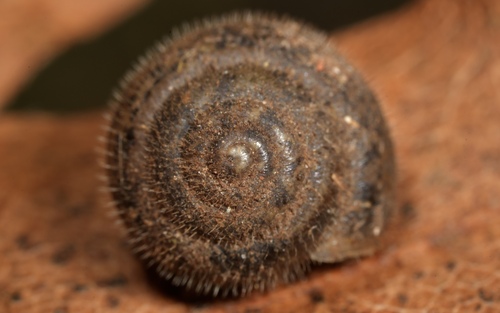
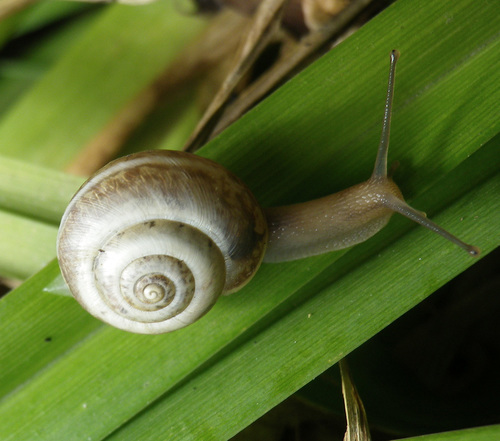
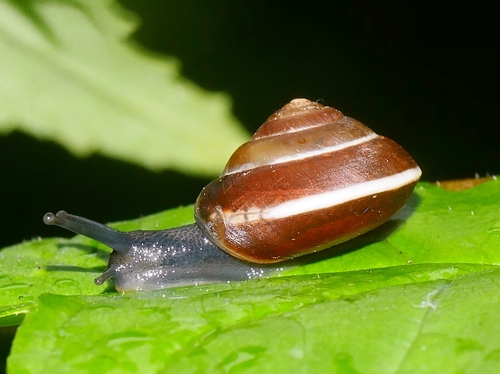
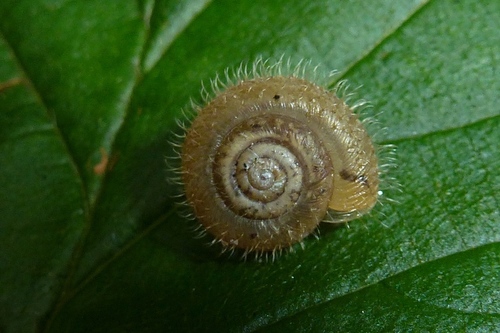
The shell of Trochulus hispidus measures 3–6 mm by 5–11 mm, and has 5–6 moderately convex whorls that are rounded, or very slightly keeled at the periphery. The aperture has a thin white lip on the inside. The umbilicus is open and usually wide, with a width equal to 1/8–1/4 of the shell’s diameter. The shell ranges in colour from brown to cream, and sometimes has a light band at the periphery. The periostracum is irregularly striated, and is densely covered with short, curved hairs that measure 0.2–0.3 mm. If the hairs wear away from the rest of the shell, they usually remain intact in the umbilicus. Hairs that are lost leave distinct, visible scars. The soft body of the snail is brownish grey, with a darker anterior region. This species is distributed across many European countries and islands. In Western Europe it is found in the British Isles (Great Britain and Ireland), the Netherlands, Belgium, Luxembourg, the Faroe Islands, France, Switzerland, and Liechtenstein. In Northern Europe it occurs in Denmark, Norway, Sweden, and Finland. In Central Europe it can be found in Austria, Germany, the Czech Republic, Poland, Slovakia, Hungary, and Romania. In Southern Europe it occurs in Andorra, Spain, Italy, and Bulgaria. In Eastern Europe it is found in Moldova, Estonia, Latvia, Lithuania, Ukraine, and the Kaliningrad region of the Russian Federation. The eggs of this species measure 1.5 mm in size. In 2010, a hairy snail of this species was found in the plumage of a great tit (Parus major) wintering in southwestern Poland. This great tit represents the smallest bird species ever reported to carry a gastropod.