About Trochalopteron fairbanki Blanford, 1869
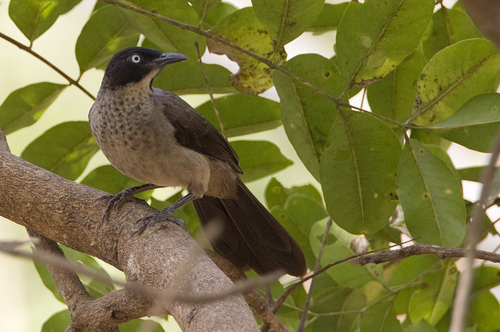
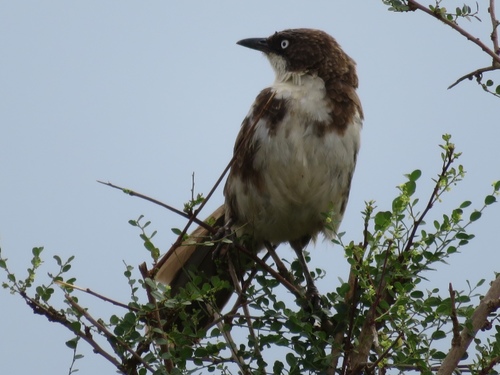
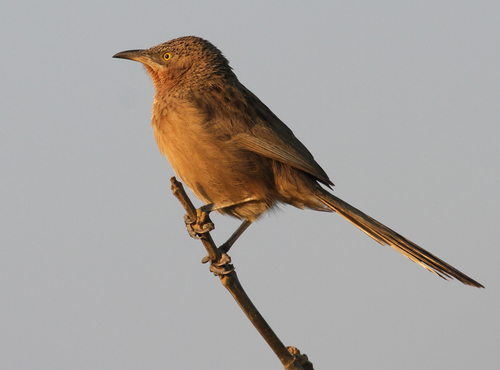
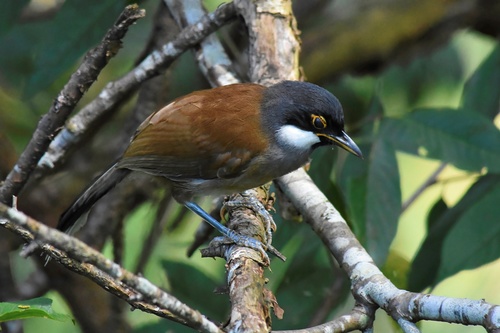
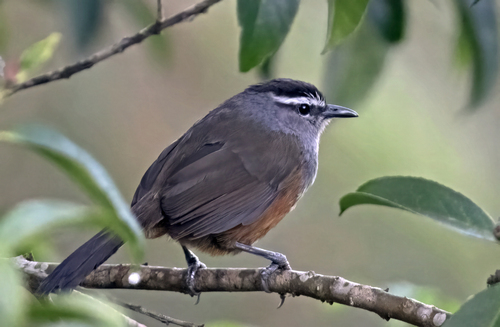
This species, Trochalopteron fairbanki, has a dark grey-brown crown, a narrow dark grey eyestripe, and a broad white supercilium above the eyestripe that extends behind the eye (in the closely related meridionalis, the supercilium stops above the eye). Its throat is distinctly grey, unlike the black-chinned laughingthrushes found north of the Palghat Gap, and this grey colouration continues into the upper breast. The grey of the upper breast has faint brown streaks. The lower breast and belly are rusty brown, and the upper parts are olive brown. Its bill is browner, and not as dark grey as the bill of the black-chinned laughingthrush. The Ashambu laughingthrush (M. meridionalis), which was previously classified as a subspecies of this species, has greyer upper plumage, a paler crown, a white belly centre, and chestnut brown flanks and vent. Trochalopteron fairbanki has a dark red or red-brown iris, and the sexes cannot be distinguished from each other in the field. This species is restricted to areas south of the Palghat Gap, with its main distribution range in higher regions (above 1,100 metres, or 3,600 feet) of the Palani Hills, extending into the Annamalai Hills in western Tamil Nadu and Munnar in Kerala. The nominate subspecies occurs north of the Achankovil gap, while the subspecies meridionale occurs in the hills south of the gap. In the Palni Hills, population densities vary across locations: 1.4 birds per hectare at Kukkal, 0.5 birds per hectare at Poombarai, 0.33 birds per hectare at Kodaikanal Botanical gardens, 0.16 birds per hectare on the golf course, and 0.22 birds per hectare at Paricombai. Trochalopteron fairbanki occurs in pairs and small groups, and sometimes joins mixed-species feeding flocks. It feeds on nectar from flowers of Lobelia excelsa, Rhododendron, and Strobilanthes species. It also eats petals of some flowers including Strobilanthes, and fruits from a range of plants including Viburnum, Eurya, Rubus, and Rhodomyrtus tomentosa. The breeding season runs from December to June, with peak activity in April and May. The nest is a cup-shaped structure built from grass and moss, lined with fine fibre, and placed in a low fork hidden within dense vegetation. The usual clutch is two blue eggs with reddish markings, which are indistinguishable from the eggs of the black-chinned laughingthrush. After the nest is predated or after the young fledge, the nest is destroyed. Parent birds may also tear up nests of other birds located nearby, and will eat unhatched eggs. The contact calls of this species are very loud, consisting of a series of steeply ascending notes pee-koko... pee-koko followed by more abrupt notes. Many other vocalizations, such as low kweer calls, are produced in different behavioural contexts, and some calls appear to be antiphonal duets.