About Trivia monacha (da Costa, 1778)
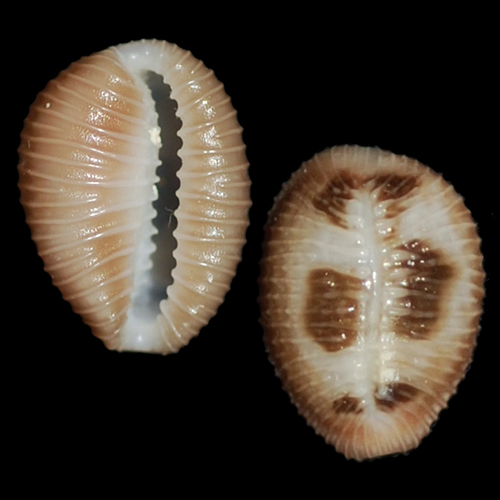
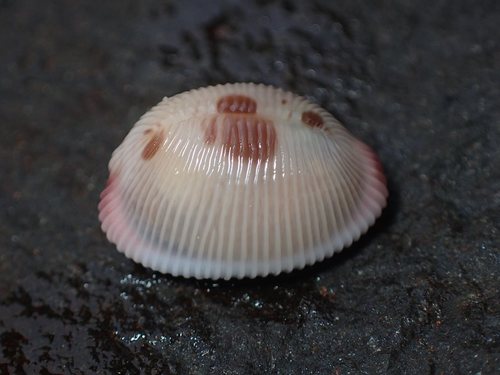
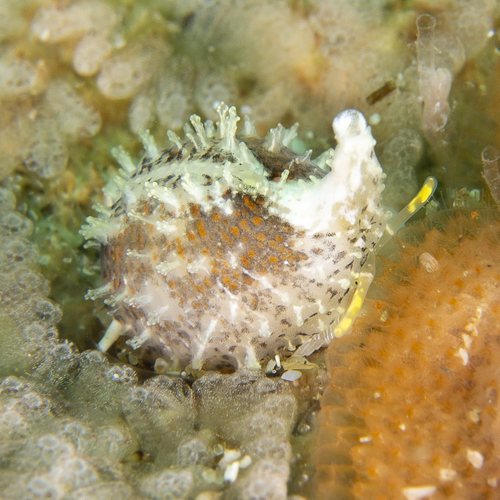
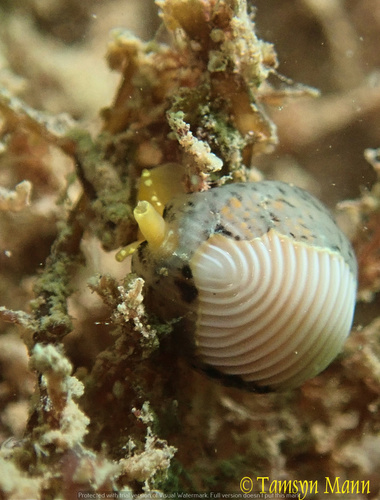
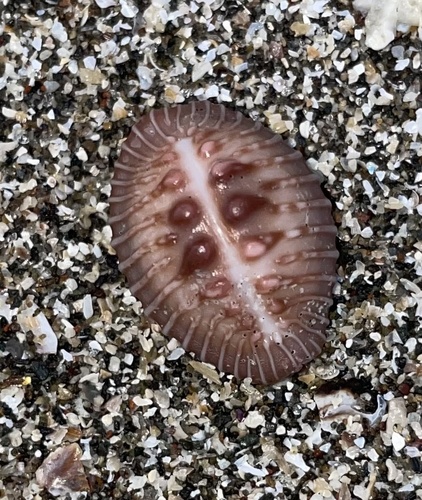
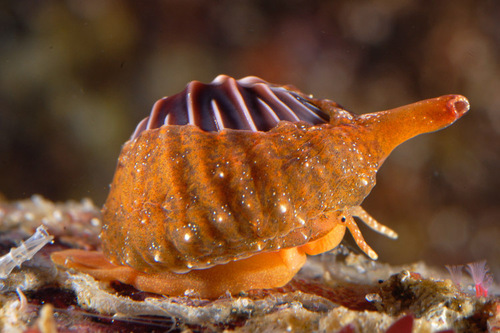
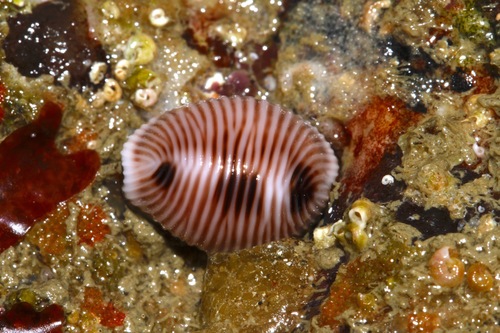
The shell of Trivia monacha is glossy, convolute, and lemon-shaped, with 20 to 30 transverse ridges. Mature individuals have a pinkish or reddish-brown dorsal shell with three characteristic darker spots aligned along a central line: one near the anterior end, one near the posterior end, and one in the center. Juvenile shells are entirely white or light-colored. The apertural side of the shell is white and flattened. The aperture is narrow, runs along the full length of the shell, and curves left toward the swollen body whorl at its ends. The transverse ridges are strong, often split into two branches, and are nearly U-shaped at the shell's ends. The shell reaches a maximum length of around 15 mm and maximum width of around 8 mm. This species has a dark mantle covered in a small number of papillae, which are usually tipped with pale yellow. The mantle extends forward into a long siphon that stretches over all, or almost all, of the shell. The foot is orange or bright yellow. The breeding season of Trivia monacha falls in late spring or summer. Its larvae have very dark stomachs and intestines. More developed veliger-stage larvae have a two-lobed velum, a structure used for swimming and collecting particulate food, which is slightly indented along its sides. Larvae develop into their adult form in approximately five to six months. This species is found from the Mediterranean Sea north to the Shetland archipelago off northern Scotland, and it is more common in the southern part of this range. In Orkney and some other parts of Scotland, the species is known locally as 'groatie buckies' and is popular among local collectors. Trivia monacha typically inhabits rocky shores or areas under stones below the low tide line, making it a sublittoral species, though empty shells of the species are often washed onto beaches. It is usually found living alongside compound ascidians of the genera Botrylus, Botrylloides, and Diplosoma. Trivia monacha does not have small denticles on the admedian teeth of its radula. Additionally, the arrangement of tooth rows differs between this species and the related Trivia arctica.