About Triturus marmoratus (Latreille, 1800)
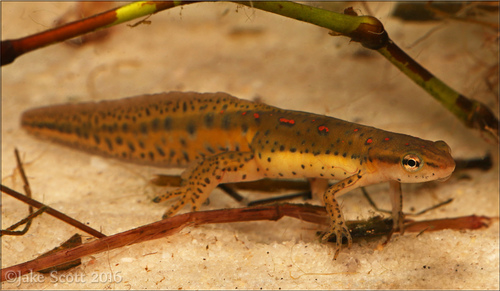
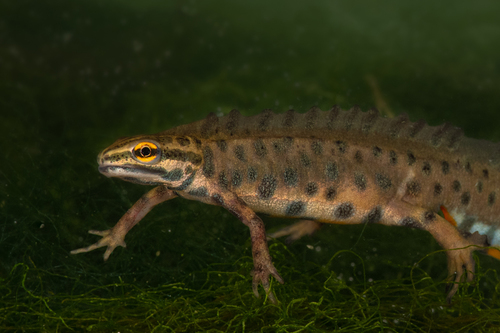
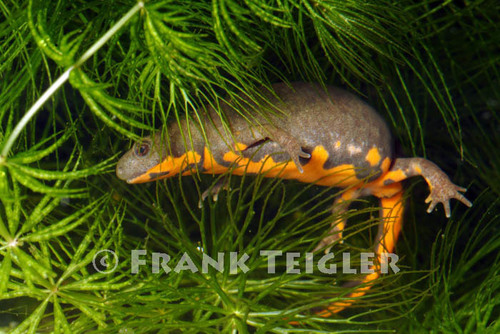
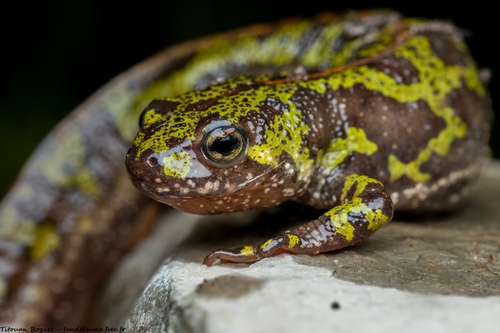
Triturus marmoratus, commonly called the marbled newt, has dark brown or black bodies covered with irregular green patterns. Their bellies are black and dotted with off-white specks. Adult females and juveniles have an orange stripe running along their back from the head to the tip of the tail; this stripe fades in males when they reach around 9 months old. Breeding males grow a large, wavy crest that extends from the neck to the tip of the tail, which is slightly shorter at the junction between the body and tail. The crest has black stripes on a yellowish-white background. Adult marbled newts measure between 13 cm (5 inches) and 17 cm (6.5 inches) in length.
Marbled newts typically inhabit hilly, forested areas, staying away from open, exposed terrain. They occupy temporary habitats like shallow ponds that change with regional climate conditions. When rainfall is high and temperatures are cool, usually during fall and winter, adult marbled newts stay in these ponds. In warmer spring and summer, these shallow ponds dry out due to drought, forcing the newts to move onto land. This constant habitat change means marbled newts have adapted to a wide range of climatic conditions and habitat shifts. The characteristics of their habitat also affect the sexual maturity of both male and female newts: marbled newts living in Mediterranean regions mature earlier than populations in France and Portugal. The harsher Mediterranean climate leads to higher adult mortality, so earlier maturation is an advantageous adaptation for these populations.
Different environmental conditions cause changes in bone density and formation for marbled newts living in different regions. Like many other amphibians, marbled newts grow during spring and summer, then stop growing over winter. Tracking these growth patterns is an important benchmark for research, as climate change is significantly altering the environmental conditions the species is adapted to.
The marbled newt breeding season starts in February, and larvae hatch in late March. Metamorphosis occurs from April through the end of June, and juvenile newts leave the breeding pond by the end of June at the latest. During the hottest part of summer between July and September, breeding ponds dry up, leading to a sharp drop in the newts' activity. Activity increases again when rain returns in August.
Marbled newts primarily rely on celestial cues to locate breeding ponds. When these cues are unavailable, the newts do not migrate. When tested under clear and overcast sky conditions, the newts were unable to orient themselves correctly. Altering the local geomagnetic field did not change the newts' orientation, indicating geomagnetic changes do not affect their navigation. Other potential orientation cues include specific pond odors and visual landmarks. Acoustic cues are also used by marbled newts to find breeding ponds; they sometimes use the mating calls of the frog *Bufo calamita* to locate suitable breeding sites. While newts do not have ears as complex as human ears, they have inner ears that can process sound. Sound can help them find breeding ponds, but celestial cues remain essential for successfully locating breeding sites.