About Triturus dobrogicus (Kiritzescu, 1903)
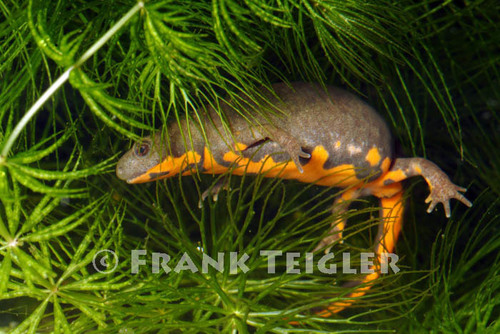
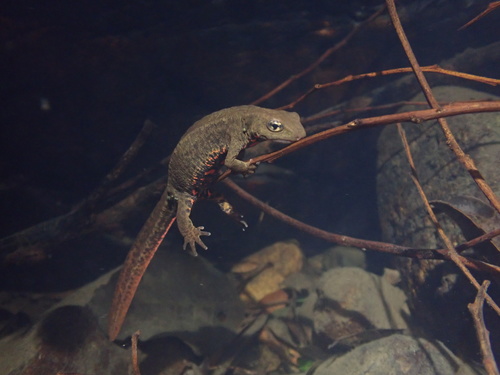
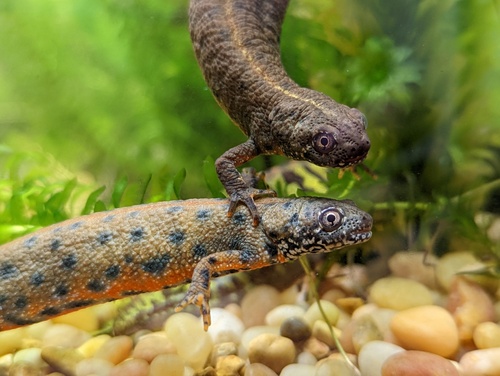
The Danube crested newt, scientifically named Triturus dobrogicus (Kiritzescu, 1903), is the smallest species of crested newt. Adults measure 13 to 15 centimetres (5.1 to 5.9 inches) in total length on average; females can sometimes grow as large as 18 centimetres (7.1 inches). Compared to other crested newt species, it has a more slender, elongated body well adapted for swimming, paired with a narrow head and relatively short limbs. This body shape evolved from an increased number of rib-bearing vertebrae: T. dobrogicus has 16–17 rib-bearing vertebrae, the highest count among all crested newts.
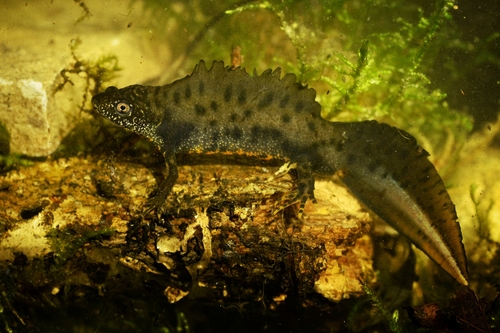
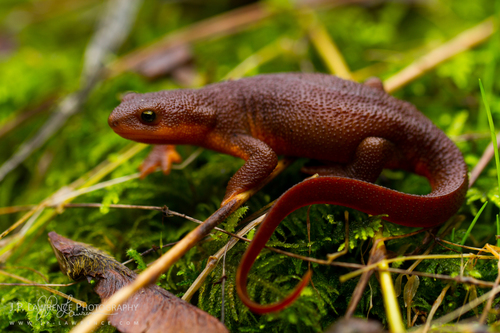
Its back and sides are dark brown, marked with black spots and white stippling. The belly ranges from orange to red, a deeper shade than the typical yellow or orange-yellow belly of other crested newts, and is covered in small to medium-sized black blotches with sharp edges. Like all crested newts, male Danube crested newts grow a crest along their back and tail during the breeding season. This crest can be quite high and jagged, usually starts between the eyes and nostrils, and is interrupted at the base of the tail. Males also have a distinctive bluish-white stripe running along the tail during breeding season. Females may sometimes have a yellow stripe along the back, similar to that seen in the Italian crested newt (T. carnifex).
The Danube crested newt has three separate allopatric distribution ranges across central to eastern Europe. The first is the Pannonian basin, which stretches from the easternmost part of Austria through southeastern Czech Republic, Slovakia, Hungary, northeastern Slovenia (in backwaters of the Mura River), northern Croatia, marginal northern Bosnia-Herzegovina, and northern Serbia, extending east to eastern Romania and southeastern Ukraine's Transcarpathian region. This range covers the middle floodplains of the Danube River and several of its tributaries, including the Drava, Sava, and Tisza.
The second range is the Lower Danube and Danube delta. This central area is separated from the Pannonian basin by a region occupied by the northern crested newt, and extends across southern Romania, northern Bulgaria, small parts of southern Moldova, to the Odesa region of southern Ukraine. The third and smallest range is the Dnieper delta in southern Ukraine, first reported in 2005. This range is currently isolated from the Danube basin by steppe, but it has been suggested the areas were connected by marshlands during the Last Glacial Maximum, when Black Sea levels were around 100 metres lower than they are today. The species' range may also extend into the lower basins of the Dniester and Bug rivers.
To the north, the Danube crested newt's range borders that of the northern crested newt; to the west, it borders the Italian crested newt (T. carnifex); and to the south, it borders the Macedonian crested newt (T. macedonicus) and Balkan crested newt (T. ivanbureschi). Compared to other crested newt species, the Danube crested newt is more adapted to living along river systems. It is often found in flowing water and occurs alongside fish. Typical breeding sites are slow-flowing river margins, oxbow lakes, flooded marshland, large ponds, or ditches, as long as abundant underwater vegetation is present. During their terrestrial life phase, the newts live in deciduous forests or groves, bushlands, or meadows.