About Triturus cristatus (Laurenti, 1768)
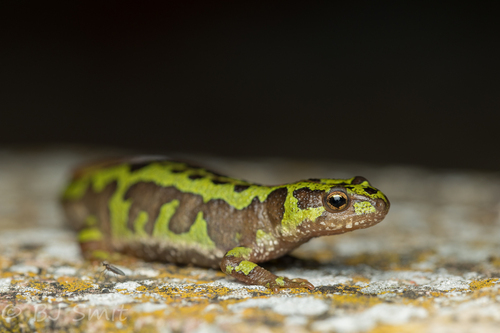
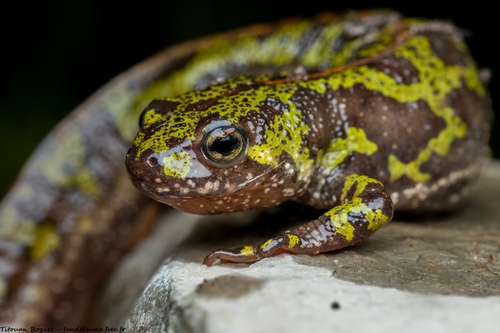
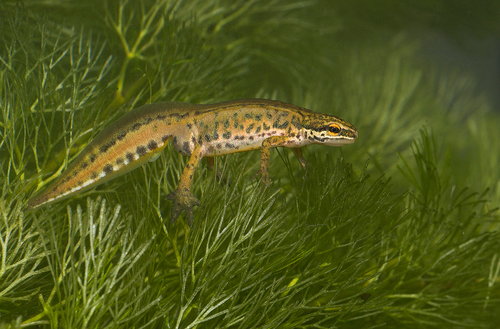
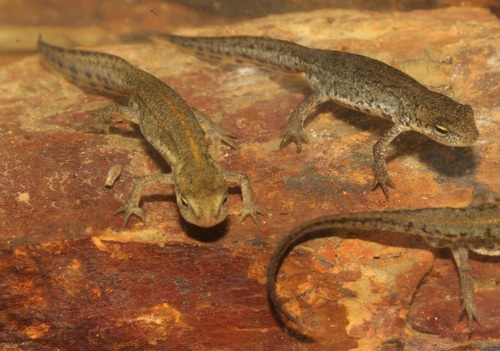
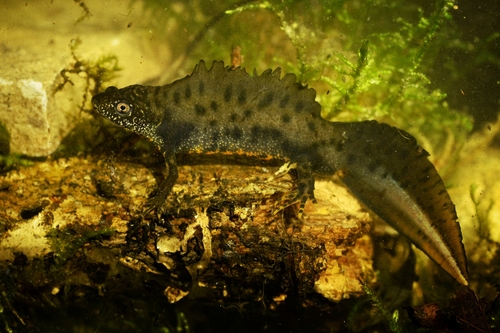
The northern crested newt, scientifically named Triturus cristatus (Laurenti, 1768), is a relatively large newt species. Males typically reach a total length of 13.5 cm (5.3 in), while females can grow to 16 cm (6.3 in); rare individuals measuring 20 cm (7.9 in) have been recorded. Most other crested newt species have a more stocky build, and only the Danube crested newt (T. dobrogicus) is more slender. Body shape correlates with skeletal structure: the northern crested newt has 15 rib-bearing vertebrae. Only the Danube crested newt has more, with 16–17 vertebrae, while other stockier Triturus species have 14 or fewer. Northern crested newts have rough skin, and are dark brown across their back and sides. They have black spots and dense white stippling on their flanks. Females have a yellow line running along the lower edge of their tail. Their throats are yellow and black with fine white stippling, and their bellies are yellow-orange with dark, irregular blotches. During the aquatic breeding season, males develop a crest that can reach up to 1.5 cm (0.59 in) high. The crest runs along the back and tail, but is interrupted at the base of the tail. It is heavily indented along the back, but smoother along the tail. During breeding season, the male's cloaca swells, and a blue-white flash runs along the sides of its tail. Females do not develop a crest. The northern crested newt is the most widespread and most northerly crested newt species. The northern edge of its range extends from Great Britain through southern Fennoscandia to the Republic of Karelia in Russia. Its southern margin runs through central France, southwest Romania, Moldavia and Ukraine, then continues into central Russia and through the Ural Mountains. The eastern extent of its range reaches into Western Siberia, running from Perm Krai to Kurgan Oblast. In western France, this species co-occurs with the marbled newt (Triturus marmoratus) and sometimes hybridises with it. In southeast Europe, its range borders the ranges of the Italian crested newt (T. carnifex), the Danube crested newt (T. dobrogicus), the Macedonian crested newt (T. macedonicus) and the Balkan crested newt (T. ivanbureschi). Outside of the breeding season, northern crested newts live mainly in forests. They prefer deciduous woodlands or groves, but also inhabit conifer woodlands, particularly in the northernmost and southernmost parts of their range. Where forests are not available, they can live in other cover-rich habitats such as hedgerows, scrub, swampy meadows, or quarries. Their preferred aquatic breeding sites are stagnant, mid- to large-sized, unshaded water bodies with abundant underwater vegetation and no fish (which prey on newt larvae). Larger ponds are typical breeding sites, and these do not need to be naturally occurring; most ponds inhabited by the species in the United Kingdom are human-made. Other suitable secondary breeding habitats include ditches, channels, gravel pit lakes, and garden ponds. Other newt species sometimes found in the same breeding sites are the smooth newt (Lissotriton vulgaris), the palmate newt (L. helveticus), the Carpathian newt (L. montadoni), the alpine newt (Ichthyosaura alpestris) and the marbled newt (Triturus marmoratus). The northern crested newt is generally a lowland species, but has been found at elevations up to 1,750 m (5,740 ft) in the Alps. Like other newts, T. cristatus develops in water as a larva, and adults return to water each year to breed. Adults spend approximately seven months of the year on land. After completing larval development in their first year, juveniles take another one to two years to reach sexual maturity; development can take longer in northern areas and at higher elevations. The larval and juvenile stages are the riskiest period for northern crested newts, while adults have a higher survival rate. After passing these early risky stages, adult newts usually live for seven to nine years, though some wild individuals have lived up to 17 years. Adult newts begin moving to their breeding sites in spring, when temperatures stay above 4–5 °C (39–41 °F), usually in March. During the aquatic phase, crested newts are mostly nocturnal, and compared to smaller newt species, they usually prefer deeper parts of a water body, where they hide under vegetation. Like other newts, they must occasionally surface to breathe air. The aquatic phase is used not only for reproduction, but also gives the newts access to more abundant prey. Immature crested newts often return to water in spring, even when they are not yet ready to breed. During the terrestrial phase, newts use hiding places including logs, bark, planks, stone walls, and small mammal burrows; multiple individuals may share the same refuge. Since newts generally stay very close to their aquatic breeding sites, the quality of the surrounding terrestrial habitat largely determines whether an otherwise suitable water body will be colonised. Northern crested newts may also climb vegetation during their terrestrial phase, though the exact purpose of this behaviour is not yet clear. Juveniles, also called efts, often disperse to new breeding sites, while adults generally return to the same breeding sites each year. Newts do not migrate long distances; they can travel around 100 metres (110 yd) in one night, and rarely disperse much farther than one kilometre (0.62 mi). Across most of their range, they hibernate in winter, mainly using subterranean hiding places, where many individuals often gather together. Like other members of the genus Triturus, northern crested newts perform a complex courtship display. The male attracts a female through specific body movements and by releasing pheromones to her. Males are territorial, and use small patches of clear ground as leks, or courtship arenas. If the male is successful, he guides the female over a spermatophore he has deposited on the ground, which she then takes up with her cloaca. Eggs are fertilised internally. The female deposits eggs one at a time, usually folding each individual egg into an aquatic plant leaf. It takes a female around five minutes to deposit a single egg, and she usually lays roughly 200 eggs per breeding season. The embryos are usually light-coloured, 1.8–2 mm in diameter with a 6 mm jelly capsule. This distinguishes northern crested newt eggs from those of other co-existing newt species, which are smaller and darker. A genetic trait shared with other Triturus species causes 50% of all embryos to die. Larvae hatch two to five weeks after laying, depending on water temperature. Like all salamanders and newts, the forelimbs develop first, and the hind legs develop later. Unlike smaller newts, crested newt larvae are mostly nektonic, swimming freely in the water column. Just before transitioning to life on land, larvae resorb their external gills. At this stage, larvae can reach a size of 7 centimetres (2.8 in). Metamorphosis into terrestrial efts occurs two to four months after hatching, again depending on temperature. Mean larval survival from hatching to metamorphosis has been estimated at roughly 4%. In unfavourable conditions, larvae may delay development and overwinter in water, though this is less common than it is in small-bodied newt species.