About Tritoniopsis elegans (Audouin, 1826)
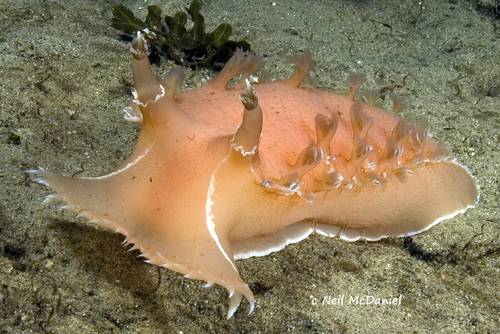
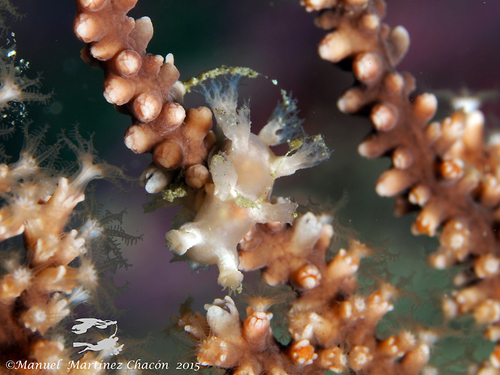
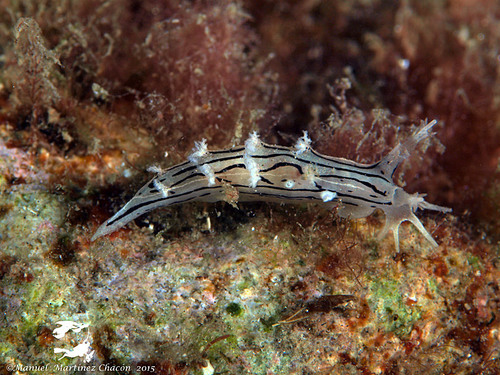
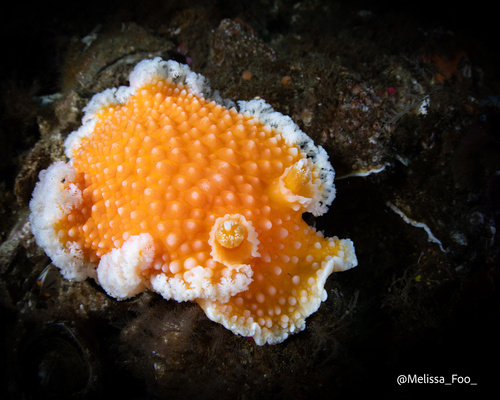
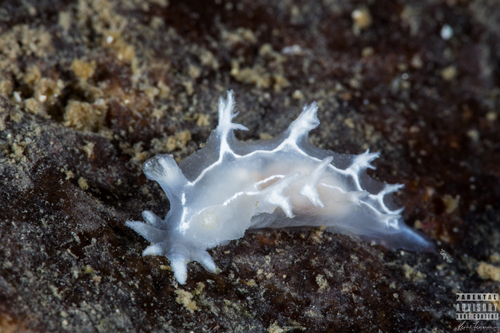
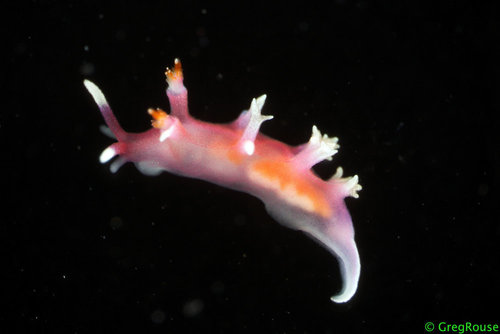
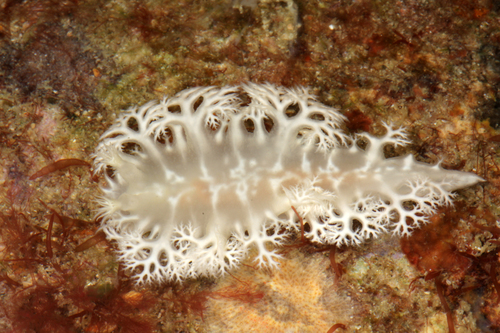
Tritoniopsis elegans (Audouin, 1826) is a slender nudibranch that reaches around 5 cm (2 inches) in length. It has several pairs of branching dendritic cerata, and its rhinophores are tipped with short tentacles. Its colour ranges from translucent clear, to translucent orange, to orange-red, with a pattern of opaque white markings. Different colour forms do not appear to be caused by the species' diet, because both forms can sometimes be found living and feeding together on the same colonial soft coral. The white colour form was previously classified as a separate species, Tritoniopsilla alba, but this name is now considered a synonym of T. elegans. This species was first described from specimens collected in the Red Sea, and has been recorded at many sites across the western Indo-Pacific. Confirmed recorded locations include the Red Sea, Tanzania, Japan, New Caledonia, and eastern Australia. It inhabits shallow water reefs, and is most commonly found on the soft corals that it feeds on. It is nocturnal, so it is easily missed by observers. In 2007, T. elegans was first recorded in Hawaii, after being absent from all prior marine invertebrate surveys of the islands. Ecologically, T. elegans is one of only a few known predators that feed on the invasive octocoral Carijoa riisei. The only other confirmed predators of this coral are the aeolid nudibranch Phyllodesmium poindimiei and the bearded fireworm Hermodice carunculata. This nudibranch also feeds on the Chinese octocoral Cladiella krempfi. Unusual diterpenes from this coral have been found to accumulate in the nudibranch's mantle tissue.