About Tritia mutabilis (Linnaeus, 1758)
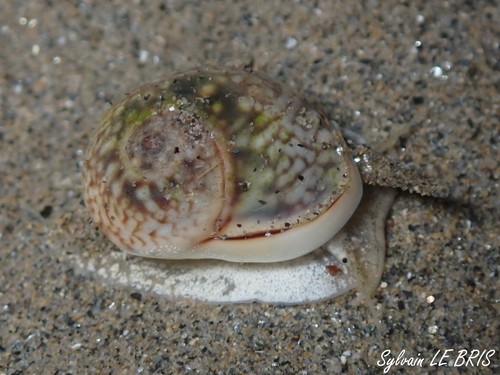
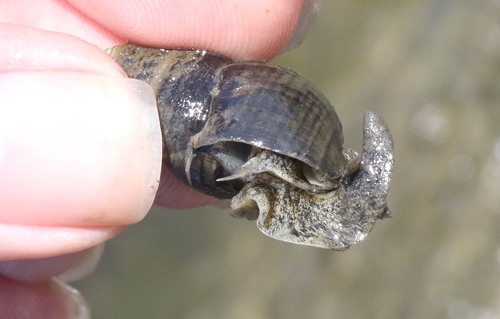
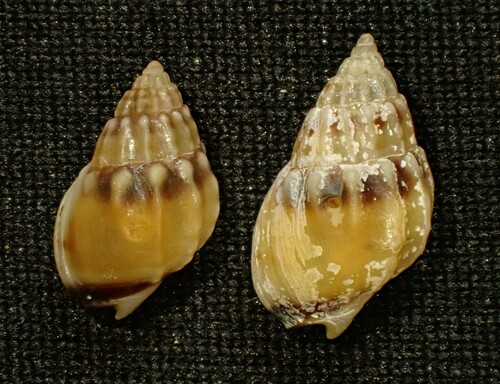
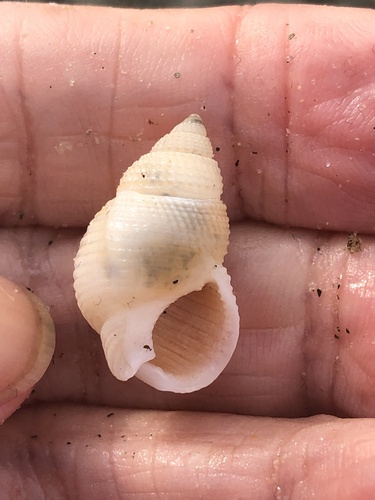
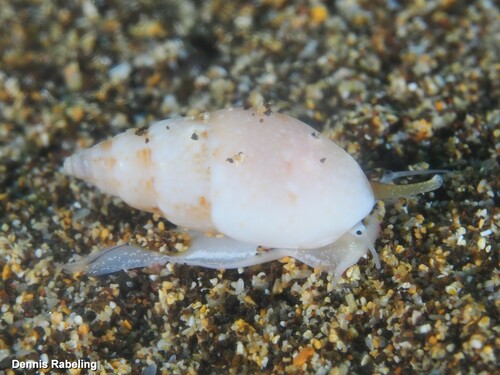
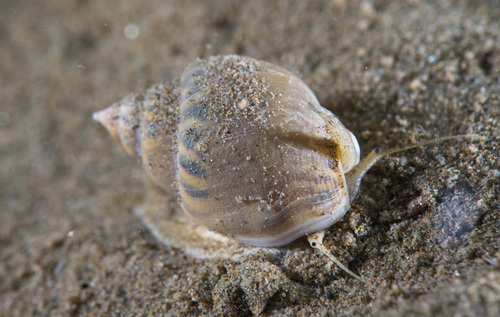
The adult shell of Tritia mutabilis ranges in size from 14 mm to 30 mm. This smooth shell is ovate, conical, and slightly ventricose. The spire is made of seven whorls, which are rounded and swollen at the upper part, particularly the lowest whorl, which is larger than all other whorls combined. The three uppermost whorls have fine folds. The body whorl has a small number of fine, transverse striae near its base. The aperture is white, ovate, strongly emarginated, and oblique at the base. The depth of the shell cavity is chestnut-colored. The thin outer lip is white, with very fine striae on its internal surface. The inner lip is thin, white, and shining, and partially covers the body of the shell. The columella is arcuated, and terminates at the base with a sharp, slightly projecting keel. The exterior of the shell is red or fawn-colored, decorated with an articulated band of white and violet along the upper edge of the whorls, as well as wavy longitudinal yellow or red spots that can range from very deep to very pale in tint. This very common species displays notable color variations. Sometimes the base ground color of the shell is red, and it is covered from end to end with either crowded, wavy white flames or distant brown longitudinal lines. At other times, the shell is whitish, a change that occurs when the shell has been exposed to light for a long period; in this whitish form, transverse striae are visible on the shell's surface. In all these color varieties, the articulated band along the suture is always present. This species is distributed in the Mediterranean Sea, the Black Sea, and the Atlantic Ocean off the coasts of Mauritania and West Africa.