About Tritia incrassata (Strøm, 1768)
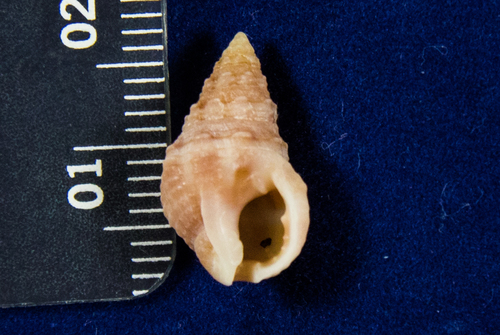
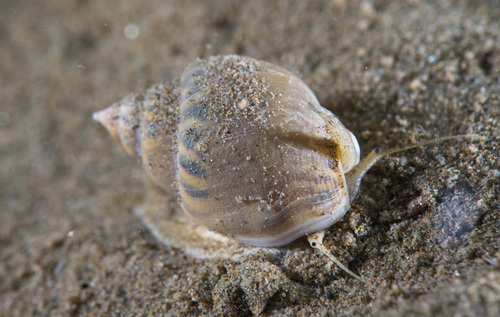
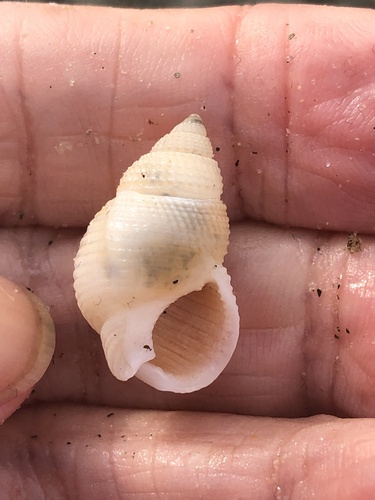
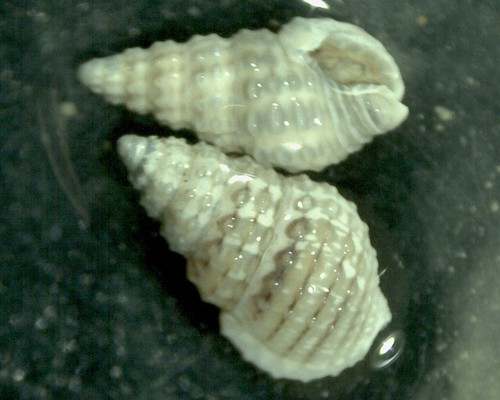
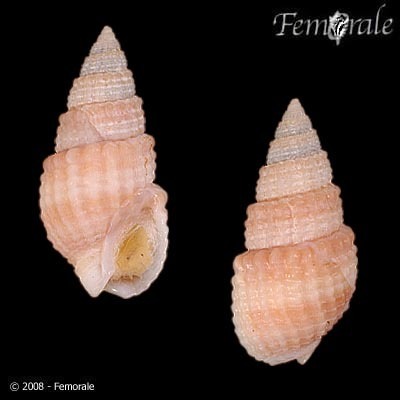
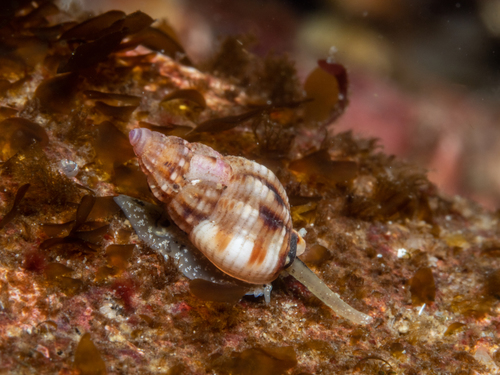
The maximum height of the shell of Tritia incrassata is 15 mm, featuring a rather high spire and a rounded body whorl. Its small protoconch is distinctly cyrtoconoid, with 2.5 smooth whorls. The teleoconch has 6–7 convex whorls, sculpted with regular spiral cords that are broader than the interspaces between them. The axial folds of the teleoconch become distinctly flexuous on the body whorl. The aperture is externally bordered by a strong varix that forms a rim; this rim is normally a unique feature that does not repeat at earlier growth stages on the spire. The inner surface of the outer lip holds approximately 10 denticles, which are elongated along the spiral direction. The parietal edge of the aperture forms a very thin, appressed callus that bears a distinct adapical denticle, and this callus continues into a thicker columellar callus with a slightly raised edge. A groove at the base of the body whorl delimits the outer portion of the siphonal canal. The shell colour is extremely variable, with distinct combinations of brown, black, yellowish, or orange hues. Most often, shells have a paler band on the abapical part of the spire whorls and on the periphery of the body whorl. Colour can also be arranged in bands, in spiral series of blotches, or be uniform across the shell. The aperture is white, with a highly diagnostic black blotch inside the siphonal canal. This species is found in European waters, throughout the Mediterranean Sea, and in the Eastern Atlantic Ocean ranging from Norway to southern Morocco; it also occurs off the Canary Islands and the Azores. It inhabits depths from the shoreline down to approximately 100 m.