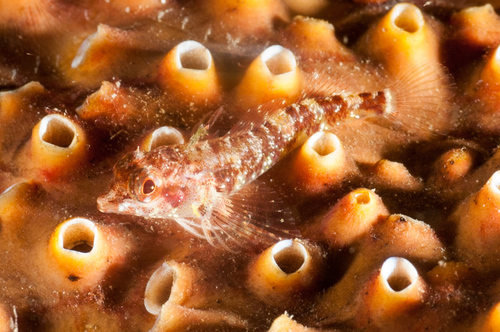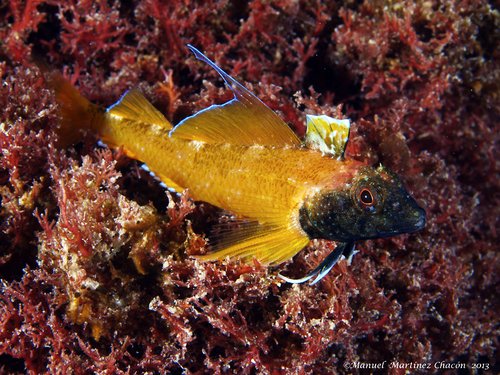
About Tripterygion delaisi Cadenat & Blache, 1970
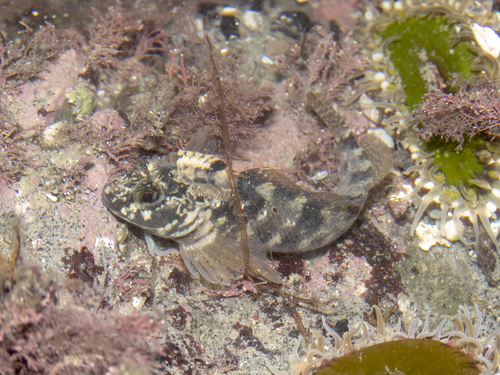
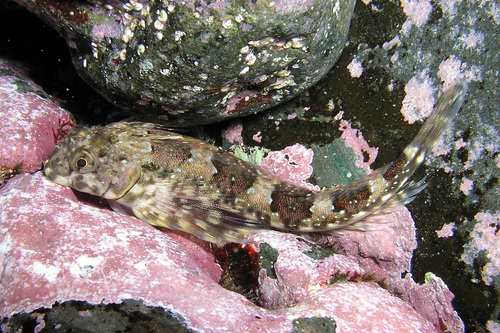
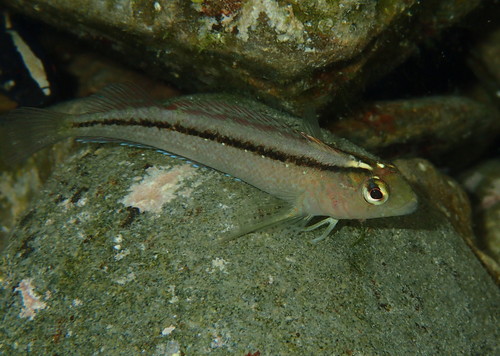
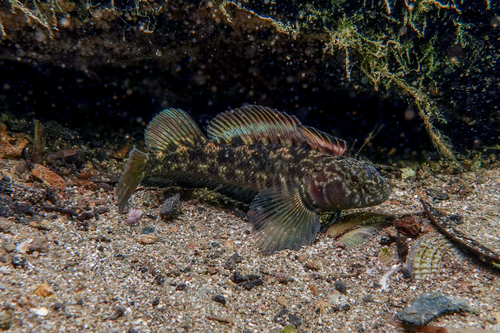
The black-faced blenny, scientifically Tripterygion delaisi Cadenat & Blache, 1970, is a small benthic fish belonging to the triplefin-blennies family Tripterygiidae. It is found at depths between 3 and 40 meters, and lives on the substrate underneath large rocks, cliffs, and other overhangs. T. delaisi inhabits two separate, disjunct areas: first, the western Mediterranean Sea and adjacent Atlantic waters, extending north to the British Isles and south to areas off Casablanca, Morocco; second, western tropical Africa north to Senegal, along with the Macaronesian islands. While it can live at depths between 3 and 40 meters, it is most commonly found at depths from 6 to 25 meters. It prefers shaded, dark habitats, including shady rock faces, overhangs, and crevices. In the Atlantic Ocean, T. delaisi can be observed out in the open without cover even in shallow water, but in the Mediterranean Sea, it can only be seen out of cover at depths below 10 meters. This difference can be explained by a lack of competition for habitat. In the Mediterranean Sea, the related species T. tripteronotus lives at depths from 0 to 5 meters. In the Atlantic Ocean, T. tripteronotus is absent, so this shallow niche is available for T. delaisi to occupy. Territorial males of both T. tripteronotus and T. melanurus have red bodies with black heads. This red-black colouration produces a strong visual signal in shallow water, where red light is still abundant. However, the signal becomes less striking with increasing depth, because water absorbs long light wavelengths strongly. This may explain the depth separation between T. delaisi and T. tripteronotus in the Mediterranean, with T. tripteronotus occupying depths of 0 to 5 meters and T. delaisi only occurring below 5 meters. Males with primarily red colouration can only successfully court females in environments with enough red light, and red colour produces a stronger mating signal than yellow in shallow water. On the other hand, the yellow colouration of T. delaisi males remains relatively visible and striking even at greater depths, where they can successfully court females. For reproduction, the overall territorial period for male black-faced blennies lasts from the beginning of February to the beginning of September. A study in Corsica found that the average duration of the territorial period per individual male is 47.1 days. Males of T. delaisi display territorial behaviour for two consecutive years. Spawning occurs from mid-March through June. Male territories are located on the lower side of overhanging cliffs and rocks, and have a diameter of around 1 meter. If two territories are visually hidden from one another, their centers can be as close as 0.5 meters apart. Within each territory, males use a smaller 20 by 20 centimeter area for nesting. Male T. delaisi are able to navigate back to their territories from distances of up to 200 meters away.