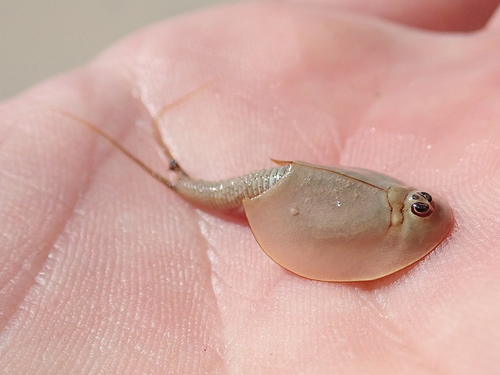
About Triops longicaudatus (LeConte, 1846)
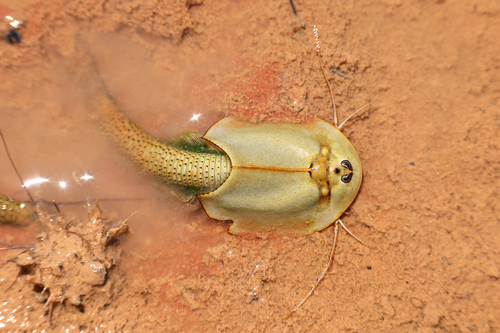
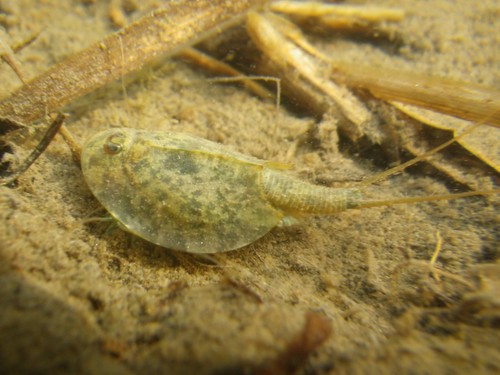
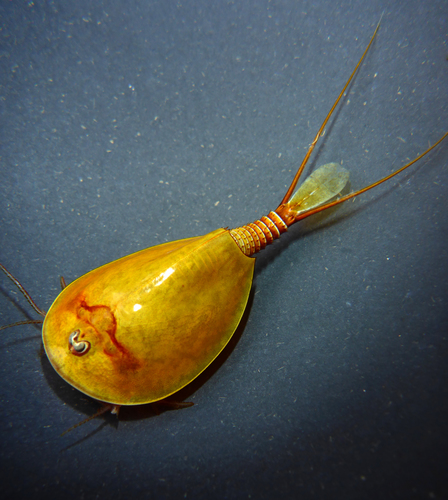
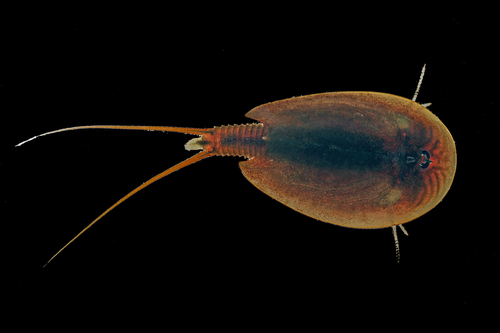
Triops longicaudatus, commonly called American tadpole shrimp or longtail tadpole shrimp, is a freshwater crustacean belonging to the order Notostraca, and it resembles a miniature horseshoe crab. This species has an elongated, segmented body, a flattened, shield-like brownish carapace that covers two thirds of the thorax, and two long filaments on the abdomen. Triops longicaudatus lives in freshwater ponds and pools, often in habitats where very few higher forms of life can survive. This species is widespread across North America. In Canada, it is only found in the provinces of Alberta, Saskatchewan, and Manitoba. It occurs widely across the contiguous United States, Mexico, and Hawaii, and is not present in Alaska. It has also been recorded in parts of South America including Argentina and the Galápagos Islands, the West Indies, and the Pacific Islands, with additional populations reported in Mongolia, Japan, South Korea, and New Caledonia. Triops longicaudatus uses multiple reproductive strategies. Sexual reproduction occurs in this species, but it is rare, because most populations are heavily skewed toward either males or females. Parthenogenesis, or development from unfertilized eggs, is the most common reproductive strategy for this species. Some populations are made up entirely of hermaphrodites that fertilize one another. Different populations use different strategies or combinations of strategies, which means these populations may be reclassified as separate species or subspecies in the future. In female Triops longicaudatus, the eleventh pair of legs is modified into egg sacs, where eggs are carried for several hours. Eggs are released in batches, and have a thick hard shell that allows them to tolerate both freezing temperatures and drought. This tolerance helps populations survive through unfavorable seasons to the next suitable growing period. Eggs must dry out completely before they can successfully hatch when re-submerged in water, and they can remain in a state of diapause for up to 20 years. These durable eggs are thought to have helped Triops longicaudatus and other notostracans survive the many natural disasters and mass extinctions that have occurred up to the present day. To complete their life cycle, tadpole shrimps rely on the changing conditions of the temporary waters they inhabit. During the dry season of summer and autumn, the species' offspring remain dormant inside their eggs. When seasonal rain fills their pools in winter and spring, the eggs hatch, and young Triops feed on fairy shrimp and other invertebrates. The first larval stage, called the metanauplius, is orange, has a single eye and six legs, and develops through distinct growth stages called instars. Each instar ends with the individual shedding its exoskeleton. As Triops grow, the number of body segments and appendages increases, and their color slowly changes to greyish brown. They reach maturity and start laying eggs in approximately eight days. Adult Triops die once their habitat pools dry up, and if their pool does not dry out, they generally live between 20 and 90 days total. T. longicaudatus is the most widespread notostracan species, and can be found in western North America, South America, Japan, South Korea, and several Pacific Islands. It is most active at a temperature of around 20 °C (68 °F). It is usually found scraping at the mud at the bottom of pools while searching for benthic food. Triops collect food particles by straining water through hairs on their limbs. Loose food particles are gathered in a groove that runs lengthwise down the underside of the body, and held together by a sticky secretion until they are swallowed through the animal's very small, 2 mm wide mouth. The tiny mouth is located deep on the animal's underbelly. While Triops longicaudatus can break apart plant roots or dead fish, it cannot chase and consume prey larger than itself.