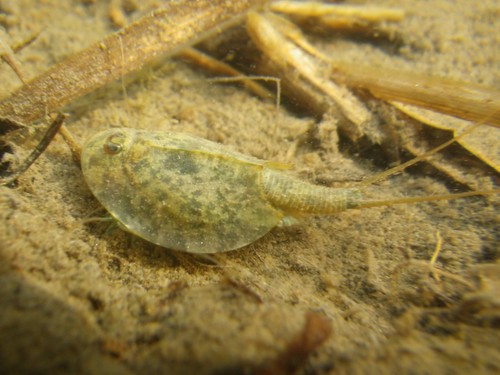
About Triops cancriformis (Bosc, 1801)
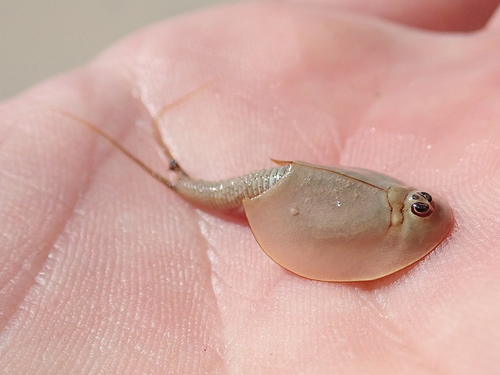
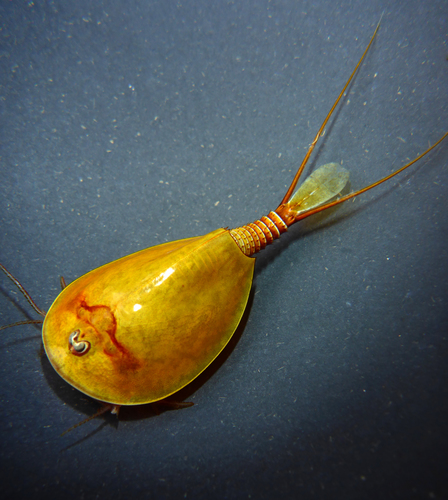
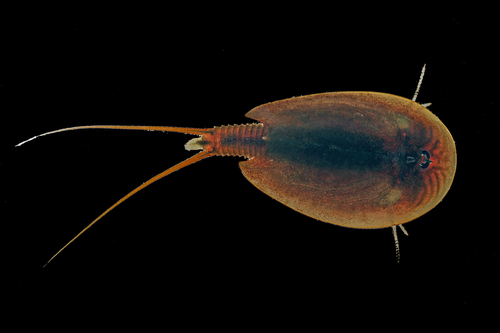
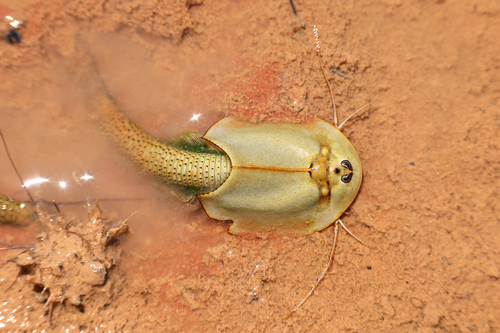
Triops cancriformis, commonly called the European tadpole shrimp or simply tadpole shrimp, is a species of tadpole shrimp that ranges from Europe through the Middle East to India. Widespread habitat destruction across its European range has caused the recent loss of many local populations, leading the species to be classified as endangered in the United Kingdom and several other European countries. In captivity, individuals commonly reach up to 6 centimetres (2.4 inches) in length; wild specimens can grow as large as 11 cm (4.3 in). In the UK, only two populations are currently known: one in a pool and adjacent area at Caerlaverock Wetlands in Scotland, and a second in a temporary pond in the New Forest. The species receives legal protection under Schedule 5 of the amended Wildlife and Countryside Act 1981. Historically, fossils from the Lower Triassic of France and Upper Triassic of Germany were assigned to this species, with some even classified as the subspecies T. c. minor. Later research reclassified all of these Triassic specimens into different extinct taxa of uncertain family: the notostracan Apudites antiquus, and the diplostracans Olesenocaris galli and Grauvogelocaris alsatica. A putative Lower Permian subspecies from France has also been redescribed as the separate notostracan taxon Heidiops permiensis. Genetic evidence shows that T. cancriformis only diverged from other Triops species between 23.7 and 49.6 million years ago. Triops cancriformis has a very rapid life cycle, with individuals reaching maturity roughly two weeks after hatching. Its populations may exhibit gonochory, hermaphroditism, or androdioecy. Androdioecy is a very rare reproductive mode in animals, where populations consist mostly of hermaphrodites with only a small share of males. This lack of males led early researchers to incorrectly conclude that Triops reproduced through parthenogenesis. The presence of testicular lobes scattered within the ovaries of individuals confirmed that they are actually hermaphroditic. Fertilized females and hermaphrodites produce diapausing eggs, also called cysts, that can remain viable for decades in the sediment of the ponds and lakes the species inhabits. These eggs are resistant to both drought and extreme temperatures. While most members of the genus Triops have no economic significance, the Beni-kabuto ebi albino variant of Triops cancriformis has been used to control mosquitoes and weeds in Asian rice fields. Triops cancriformis is the second most popular species raised by hobbyists, after Triops longicaudatus. Hobbyists value it particularly for its lower hatching temperature, somewhat longer lifespan, and potential for larger size.