About Triodia scariosa N.T.Burb.
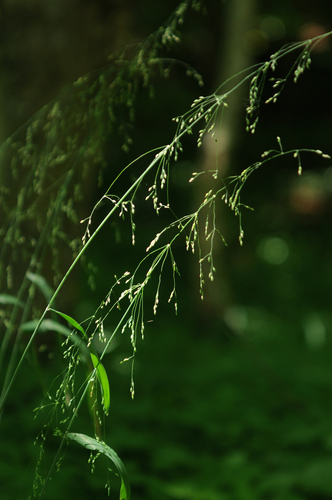
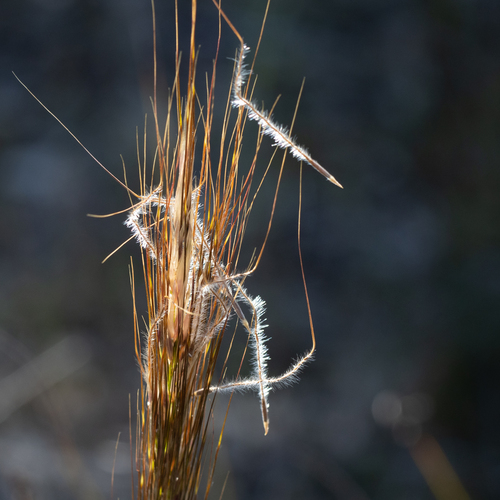
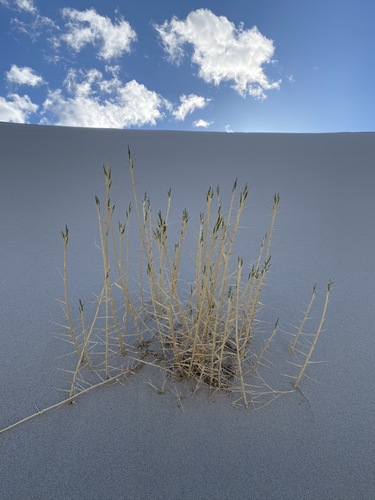
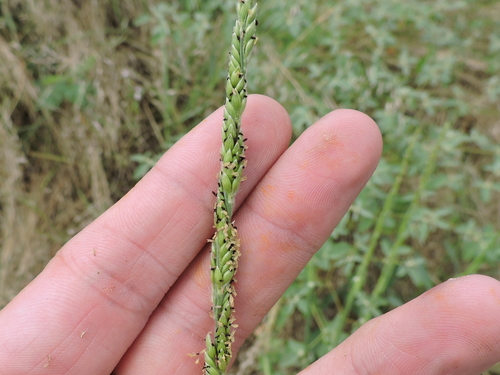
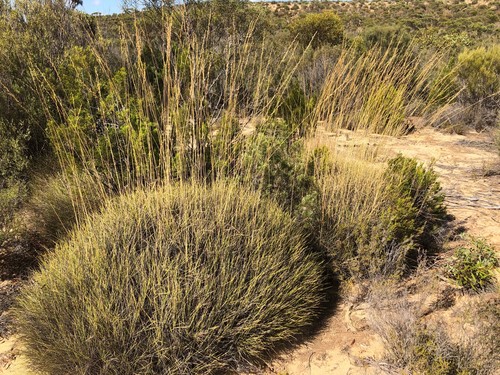
Triodia scariosa N.T.Burb. is commonly known as porcupine grass or spinifex, and is not to be confused with species in the genus Spinifex. It belongs to Triodia, a grass genus endemic to Australia. This species is a perennial evergreen that grows in mound-shaped structures called hummocks, which reach approximately 1 meter in height. Its leaves are roughly 30 centimeters long, 1 millimeter in diameter, rigid, and end in a sharp, needle-like point. Its inflorescence is a narrow, loose panicle that forms a flowering stalk growing up to around 2 meters tall. The scientific name has Latin origins: Triodia refers to the three-toothed lobes of the lemma, while scariosa refers to the thin, dry glume. Triodia scariosa is common in Mallee (MVG14) and Hummock grassland (MVG20) plant communities across arid and semi-arid regions of Australia. Triodia scariosa is found throughout semi-arid and arid regions of mainland Australia south of approximately 24 degrees latitude; it is not present in the Northern Territory or Tasmania, and most populations occur in areas with a mean annual rainfall of 200 to 400 millimeters. It reaches its highest abundance in the Mediterranean-type climate of the Mallee ecosystem in Western Australia, South Australia, and western Victoria. While it also occurs in the arid interior's hummock grasslands (MVG20), it grows at much lower densities there. Its greater abundance and growth in the semi-arid Mallee ecosystem is tied to higher rainfall and the presence of yellow sandy soils, in contrast to the red sandy soils of the arid interior. Across its entire range, Triodia scariosa is a foundation species that is fundamental to ecosystem structure and resilience. A wide variety of animal taxa are associated with Triodia scariosa, including birds, mammals, reptiles, and arthropods. These animals use its complex growth structure for foraging, nesting, refuge from predators, and temperature regulation. The endangered Mallee Emu-wren (Stipiturus mallee), which is endemic to the Murray-Mallee region, relies entirely on Triodia scariosa for hunting, nesting, mating, foraging, and breeding, and rarely disperses outside of the species' hummocks. Additionally, very high lizard diversity and abundance is linked to stands of Triodia scariosa. Associated plant species vary based on the species' distribution within its range and regional climate. In the arid zone, it co-occurs with other Triodia species, and is also found alongside Acacia, Corymbia, and Eucalyptus woodland. In the southern part of its range, it is most commonly found under an overstory dominated by Mallee Eucalypts (Eucalyptus dumosa and E. socialis), but also associates with Callitris, Melaleuca, Acacia, and Hakea. Triodia scariosa grows on soils that are low in available water and nutrients. Its extensive root system provides mechanical support for soils, reducing loss of the thin aeolian topsoil layer. Triodia scariosa plays a role in landscape fire ecology. The dry fuel load from ageing individuals increases in mass in the years after fire, before plateauing and eventually declining. In the Murray-Mallee, wildfires can cover thousands of hectares and burn with high, uniform severity. Triodia scariosa forms a continuous fuel source that connects fire across the landscape, leading to top-kill of low canopy tree species. After fire, all above-ground vegetation is removed, and regeneration is uniform and predictable, including the return of associated fauna species. The interval between wildfires in this ecosystem is tied to the regeneration of Triodia scariosa over time, and the accumulation of dead core material that, under suitable climatic conditions, promotes and sustains wildfire. This accumulation is typically sufficient to support wildfire at a minimum interval of 10 to 20 years after fire, peaking at around 20 to 30 years post-fire. If rainfall is high, however, sufficient fuel can accumulate within 2 years.