About Triodanis perfoliata (L.) Nieuwl.
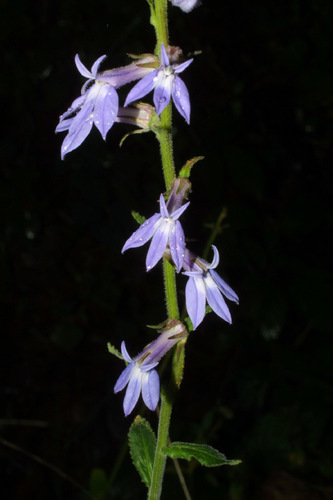
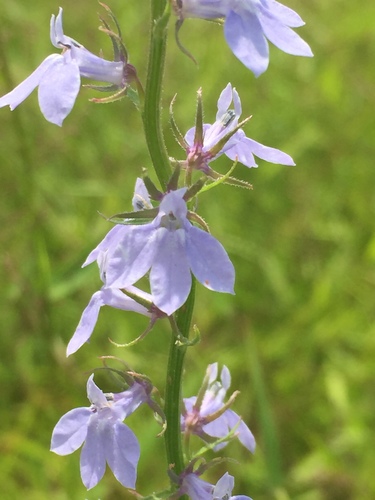
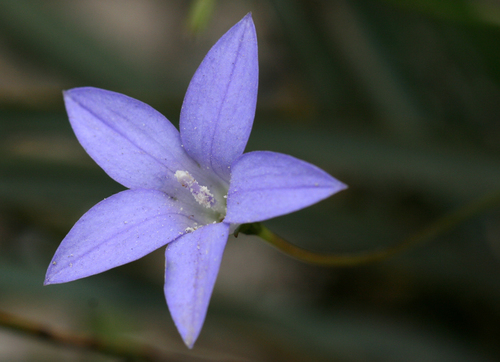
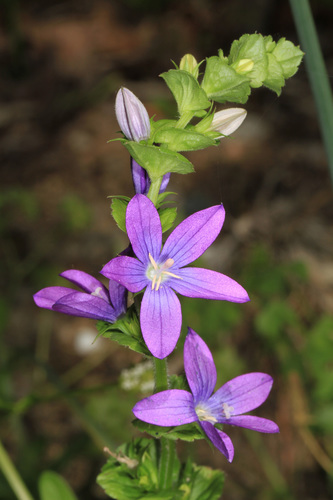
Triodanis perfoliata (L.) Nieuwl. is an annual plant that reaches 10 to 46 centimetres (4 to 18 inches) in height, and occasionally grows even taller. It has a central, unbranched, lightly hairy stem that bears alternate, clasping leaves. The leaves are light green, rounded, shell-shaped, up to 2.5 centimetres (1 inch) long, and have scalloped edges. Both the stem and leaves produce milky sap. One to three flowers grow from the leaf axils on the upper section of the stem, with only one of these flowers blooming at a time. The flowers are wheel-shaped or bell-shaped, violet blue (rarely white), roughly 1.3 centimetres (0.5 inches) across, with 5-lobed corollas and radial symmetry. Flowers on the lower part of the stem do not open, but still produce seed. The plant’s fruit is a small, multi-seeded capsule divided into 2 or 3 sections. Triodanis perfoliata is native to a large portion of North and South America. In Canada, it occurs in Ontario, British Columbia, and Quebec. In the United States, it is native to all states except Nevada, Alaska, and Hawaii. It is also native to Mexico, Costa Rica, Guatemala, Argentina, Bolivia, Brazil, Colombia, Ecuador, Paraguay, Peru, and Uruguay. This species grows in disturbed sites, open woods, grassy slopes, rocky outcrops, gravelly areas, and roadsides, and it primarily grows in poor, dry, sandy, or gravelly soil. Flowers bloom from May to August, and they attract a variety of bees, flies, butterflies, and moths. Native American groups have documented uses for this plant: The Cherokee prepare an infused liquid compound from the roots to use as a bath for dyspepsia (indigestion). The Meskwaki use the plant as an emetic to cause prolonged vomiting, and smoke it during ceremonies.