About Trioceros deremensis (Matschie, 1892)
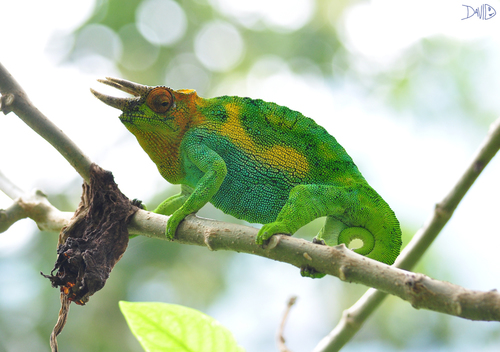
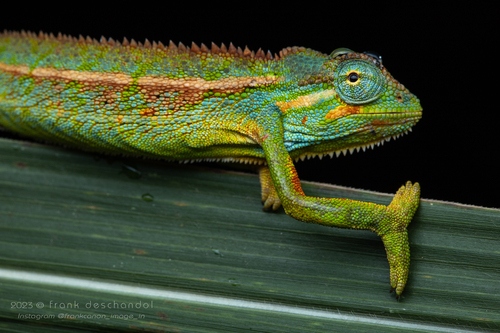
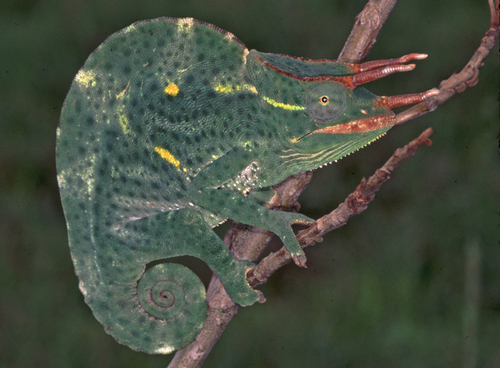
The Usambara three-horned chameleon, scientifically named Trioceros deremensis (Matschie, 1892), has a sail-like ridge on its back and can reach a total length of up to 35 cm (14 in). Males grow larger than females, and adult males have three long horns that are presumed to be used in fights between males, similar to other horned chameleon species. The horns begin to develop when the chameleon is still a juvenile, at a length of 10–12 cm (4–5 in). Females do not have horns. The species is typically overall green, often with a paler or darker pattern, and may also display some yellow coloring. When irritated, it develops black spots that can become quite prominent. This is an oviparous species, and each clutch contains 8 to 40 eggs. Newly hatched young are only 5–7 cm (2–3 in) long, and can have a purplish-whitish color. The Usambara three-horned chameleon occurs at altitudes between 800–2,300 m (2,600–7,500 ft) in the East Usambara, Uluguru, Nguu, Nguru, and Udzungwa Mountains. There is a single old record of the species from West Usambara, but its presence there is considered doubtful. Its total range covers approximately 1,400 km2 (540 sq mi). Each of its subpopulations is isolated. The species is found mostly in forests, both in the forest interior and at forest edges, but also lives in nearby hedges and plantations.