About Tringa stagnatilis (Bechstein, 1803)
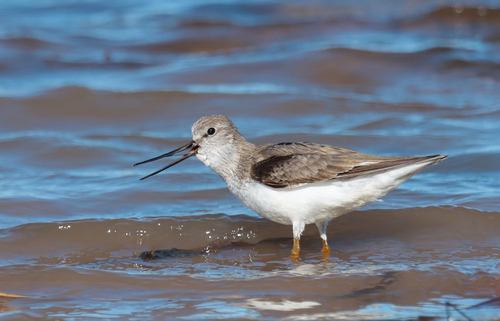
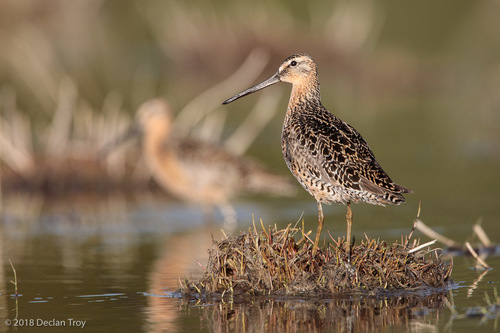
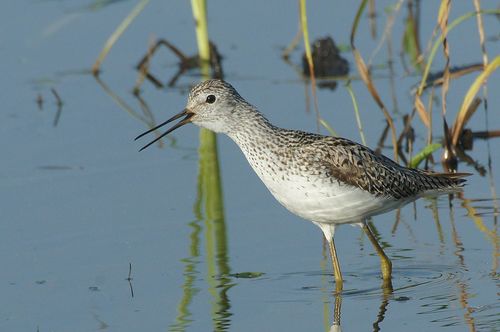
The marsh sandpiper (Tringa stagnatilis, first described by Bechstein in 1803) resembles a small, elegant greenshank, with a long fine bill and very long yellowish legs. Like the greenshank, it has greyish brown plumage in the breeding season, and paler plumage in winter, plus a visible white wedge shape on its back when in flight. Despite this resemblance, it is more closely related to the common redshank and the wood sandpiper. These three species together form a group of smallish shanks, which typically have red or reddish legs. In breeding plumage, members of this group are generally a subdued, light brown on the upper body, with some darker mottling, and a pattern of somewhat diffuse small brownish spots on the breast and neck. The marsh sandpiper measures 22–26 cm (8.7–10.2 in) in length, has a wingspan of 55–59 cm (22–23 in), and weighs 45–120 g (1.6–4.2 oz). This species breeds in the Palearctic, and is migratory. A majority of marsh sandpipers winter in Africa and India, while some migrate to Southeast Asia and Australia. During the winter, they prefer freshwater wetland habitats such as swamps and lakes, and are usually seen alone or in small groups. Marsh sandpipers are rare vagrants to North America, with most records coming from Alaska and California. The first individual recorded in Canada was observed on 30 April 2022 in Thedford, Lambton County, Ontario by James Holdsworth. This sighting attracted over a thousand birders from Ontario and Michigan, as well as birders from as far away as Texas and Washington State. A sighting of the species was also recorded in Baja California, Mexico in October 2011. The marsh sandpiper is one of the species covered by the Agreement on the Conservation of African-Eurasian Migratory Waterbirds (AEWA).