About Tringa semipalmata (J.F.Gmelin, 1789)
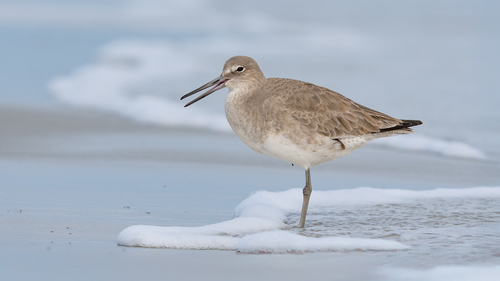
The willet, scientifically named Tringa semipalmata, is a heavily built, somewhat ungainly shorebird. Its overall body structure is similar to that of the common redshank, but it is larger in size than the greater yellowlegs. In flight, it resembles a godwit, with black primary coverts and primaries that contrast against a broad white band, white secondaries, a white rump, and a gray tail band. Following its reclassification into the Tringa genus, the willet is now the largest species within this well-known sandpiper genus. Adult willets measure 31–41 cm (12–16 in) in total length and weigh 200–330 g (7.1–11.6 oz). Males and females have similar plumage, but females are slightly larger than males. Black underwing coverts can be very noticeable when the bird is in flight. On the ground, willets are identifiable by their gray legs, and a relatively short, heavy, straight bill. Their plumage is gray on the upperparts with a white rump, and white on the underparts. There is a distinct white patch above the lores and a narrow whitish eye ring, which gives the bird a spectacled appearance. In breeding plumage, brown barring appears on the willet’s upperparts; non-breeding individuals have plainer, less patterned plumage.
Two recognized subspecies of willet (which may actually be separate full species) occupy very different breeding habitats. The eastern willet breeds in coastal saltmarshes, while the western willet breeds in freshwater prairie marshes, sloughs, potholes, and other inland wetlands. In the winter, both subspecies are coastal, occurring on rocky and sandy coasts, mudflats, and coastal marshes.
Willets are territorial on both breeding grounds and wintering grounds, but they form loose breeding colonies and loose wintering groups. During courtship display, flight displays involve holding wings stiffly and downward-curved; on the ground, displays highlight the bird’s distinctive underwing pattern. Willets are typically vigilant. Birds positioned closer to the landward edge of a saltmarsh are the first to sound alarm calls, a behavior similar to that of the European common redshank, though some individual willets may be approached easily.
Willets have flexible feeding habits. They hunt by walking steadily and pecking prey from substrate, but they also probe into mud or silt with their sensitive bill, and may actively stalk larger prey in shallow water. Favored coastal prey includes small fiddler crabs, plus mole crabs, worms, clams, and other invertebrates. They are also known to occasionally eat plant material. Willets actively hunt more mobile prey such as fish and aquatic insects in water, and will wade up to their bellies to pursue this prey. Recorded breeding prey for western willets includes water scavenger beetles (Hydrophilidae), diving beetles (Dytiscidae), snout beetles (Curculionidae), spiders (Araneae), and cypriniform fish. In winter, recorded prey for western willets includes shore crabs (Hemigrapsus), brachyuran crabs (Uca princeps, Leptuca crenulata), crabs (Pachygrapsus), clams (Macoma, Gemma gemma), nereid worms (Neanthes), mussels (Mytilus), whelks (Nassariidae), and other prey items. Eastern willets feed primarily on marine coastal prey, including fiddler crabs (Minuca minax, Minuca pugnax, Leptuca pugilator), other crabs (Armases cinereum, Sesarma reticulatum), mole crabs (Emerita talpoida), amphipods (Corophium volutator), and other marine invertebrates. The willet’s sensitive bill allows it to hunt both during the day and at night. They often perch on rocks, trees, or fence posts.