About Tringa nebularia (Gunnerus, 1767)
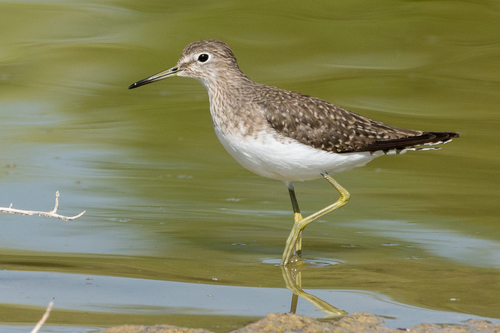
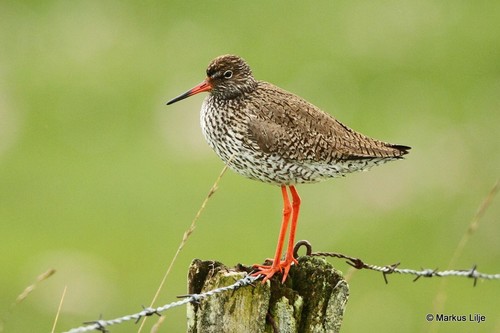
Common greenshanks (Tringa nebularia) have brown plumage during the breeding season, and grey-brown plumage in winter. When in water, they can look very similar to marsh sandpipers, but can be distinguished by the shape of their lower bill, which gives the entire bill an upturned appearance. They have long greenish legs and a long bill with a grey base. When in flight, they display a distinct white wedge on their back. They are somewhat larger than the closely related common redshank. Their typical call is a rapid sequence of three short fluty notes, which can be syllabified as teu-teu-teu. Like most waders, they feed on small invertebrates, but they will also eat small fish and amphibians. The common greenshank is one of the species covered by the Agreement on the Conservation of African-Eurasian Migratory Waterbirds (AEWA). In 2024, Tringa nebularia was listed as Endangered under the Australian Environment Protection and Biodiversity Conservation Act 1999 (EPBC Act). This is a subarctic bird species that breeds from northern Scotland eastwards across northern Europe, and continues east across the Palearctic. It is a migratory species, wintering in Africa, the Indian subcontinent, and Australasia, usually on fresh water. It breeds on dry ground near marshy areas, laying approximately four eggs in a ground scrape. Common greenshanks have been recorded as vagrants outside their normal range, including in Barbados, the United States, Canada, Bermuda, Puerto Rico, and Brazil.