About Tringa incana (J.F.Gmelin, 1789)
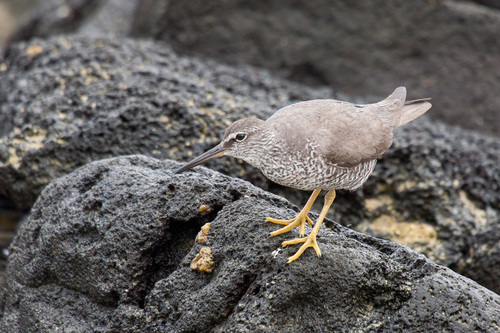
The wandering tattler, with the scientific name Tringa incana, was formally described in 1789 by German naturalist Johann Friedrich Gmelin, in his revised and expanded edition of Carl Linnaeus's Systema Naturae. Gmelin originally placed the species in the genus Scolopax, giving it the binomial name Scolopax incana. His description was based on the earlier 1785 account of the "ash-coloured snipe" published by English ornithologist John Latham in his book A General Synopsis of Birds. The specimen Latham used for his description was provided by naturalist Joseph Banks, and had been collected in 1777 by William Anderson on the island of Mo'orea in the Society Islands, during James Cook's third voyage to the Pacific Ocean. The wandering tattler was first moved to the genus Heteroscelus, which had been introduced by Spencer Fullerton Baird in 1858. In 2006, it was moved again to its current genus Tringa, following the results of a molecular phylogenetic study published the year before. The genus name Tringa is the Neo-Latin term that Italian naturalist Ulisse Aldrovandi gave to the green sandpiper in 1603, derived from the Ancient Greek word trungas, which referred to a thrush-sized, white-rumped, tail-bobbing wading bird mentioned by Aristotle. The specific epithet incana comes from the Latin word incanus, meaning "light gray" or "hoary". Tringa incana is a monotypic species, meaning no subspecies are currently recognised. Wandering tattlers have stocky bodies, with gray coloration on their upperparts, underwings, face, and neck, along with a white belly. They have short dark yellow legs and a dark gray bill. Adults measure 26–30 cm in length, weigh 60–169 g, and have a wingspan of 50–55 cm. Adult birds in breeding plumage have heavy barring on their underparts. Their call is a rapid, accelerating staccato trill, and typically includes three or four beats per call. During the summer breeding season, the wandering tattler occurs in far-eastern Russia, Alaska, portions of the California coast, and northwestern Canada. They build nests in rocky areas along mountain streams. The female lays four olive-colored eggs in a shallow depression. Both parents incubate the eggs and assist with feeding the young, which quickly become able to forage on their own. Outside of the breeding season, wandering tattlers are found on rocky islands in the southwest Pacific, and on rocky Pacific coasts ranging from California to South America, reaching as far south as Australia. In the nonbreeding season, they are widely distributed across the Pacific, and most often occupy coastlines and isolated islands. They feed on aquatic invertebrates including crustaceans and marine worms, and also eat insects during the breeding season. They forage actively while wading, making jerky bobbing movements. Their feeding behavior may include repeated returns to the same foraging location over short periods of time. They can often be seen flying low over rocky coastlines or jetties.