About Trinchesia speciosa (Macnae, 1954)
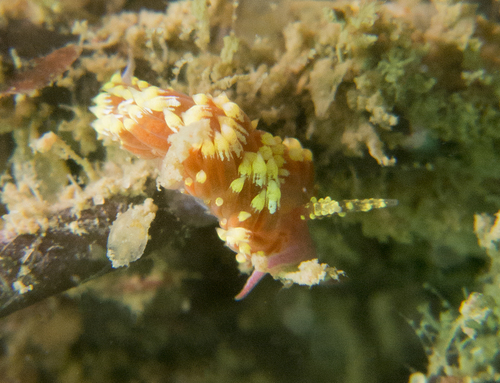
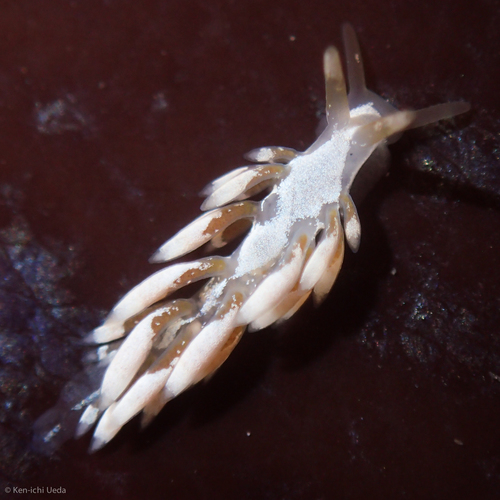
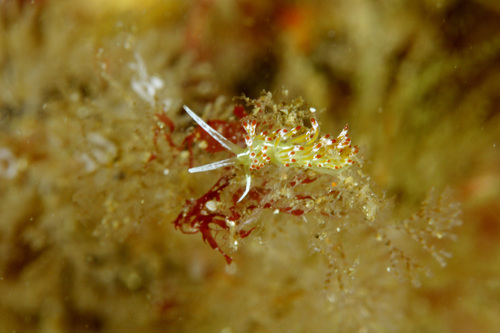
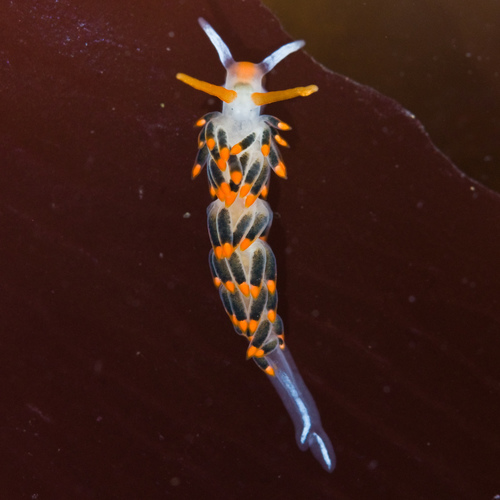
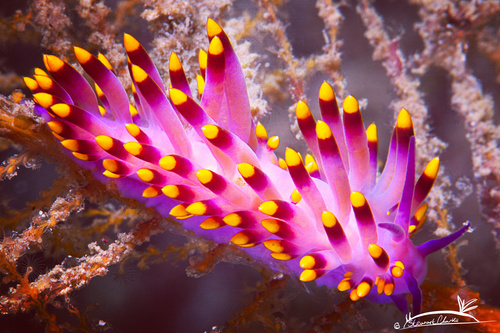
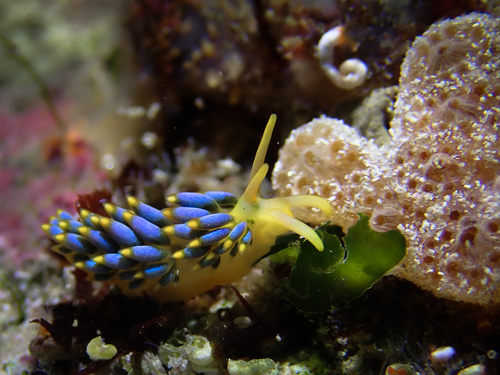
Trinchesia speciosa, commonly called the candy nudibranch, is a vividly colored nudibranch. It has a yellow-orange body and turquoise or purple cerata with yellow tips, and reaches a maximum length of 20 mm. Its rhinophores are smooth and typically yellow-orange, though they may take on the color of the cerata. Three distinct color forms of this species exist: two forms have blue cerata and yellow to orange rhinophores, while the third has lilac cerata with matching lilac rhinophores and oral tentacles. A color form (or similar species) with iridescent blue cerata was identified as Cuthona ornata by Gosliner, and as Cuthona speciosa by Rudman in 2002.
This species was first described from two specimens: one collected from a rock pool one mile south of Kalk Bay harbour, and the other found among barnacles at Dalebrook. Both localities lie in False Bay, South Africa. The candy nudibranch is endemic to South Africa, where it occurs from the Atlantic coast of the Cape Peninsula to Port Elizabeth, and can be found from intertidal areas down to at least 30 m depth.
The candy nudibranch feeds on hydroids belonging to the genus Sertularella. Like other aeolid nudibranchs, its cerata function in respiration, and also hold extensions of the digestive system. After the nudibranch eats the hydroid, it passes the hydroid's nematocysts unharmed through its digestive tract to the tips of its cerata. The nematocysts mature at this location, and are then used by the nudibranch for its own defense. It is probable that the candy nudibranch's bright colors act as a warning to predators that it is toxic. Candy nudibranchs are hermaphrodites, and their egg mass is a spiral collar of orange eggs.