About Trimeresurus stejnegeri Schmidt, 1925
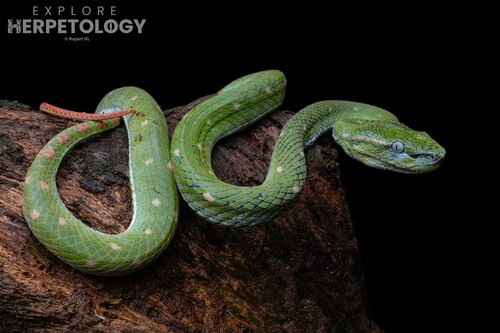
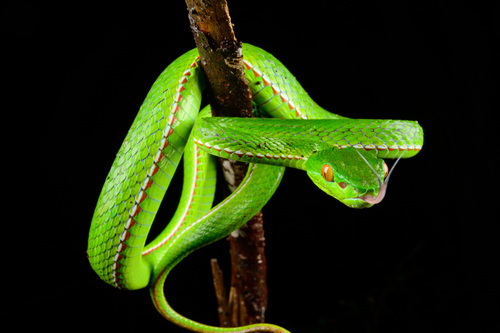
Trimeresurus stejnegeri Schmidt, 1925 reaches a maximum total length of 75 centimetres (30 inches), with a tail length of 14.5 centimetres (5.7 inches). Males have short, spinose hemipenes beyond their bifurcation. At midbody, dorsal scales are arranged in 21 longitudinal rows. There are 9 to 11 upper labials; the first upper labials are separated from the nasal scales by a distinct suture. Supraocular scales are single and narrow, and sometimes divided by a transverse suture. Between the supraoculars, there are 11 to 16 scales in a single line. Ventral scales number 150 to 174, while subcaudal scales number 54 to 77, and all subcaudal scales are paired. The species has a color pattern that is bright to dark green on the upper body and pale green to whitish on the lower body. A bright ventrolateral stripe separates these two color zones: the stripe is bicolored, with orange or brown on the lower portion and white on the upper portion in males, while it is either bicolored or entirely white in females. This stripe covers the entire outermost scale row and part of the second row. Trimeresurus stejnegeri, commonly called the bamboo viper, is a carnivorous species that feeds on small rodents, birds, frogs, and lizards. Yellow-colored mutant individuals of this species have been reported. This species is found across a broad geographic range: in India (Western Ghats, Eastern Ghats, and Northeast India), Nepal, Myanmar, Laos, most of southern China including Yunnan, Sichuan, Gansu, Jiangxi, Jiangsu, Hunan, Hubei, Guizhou, Guangxi, Guangdong, Hainan, Fujian, Anhui, and Zhejiang, Vietnam, and Taiwan. Its original type locality was listed as "Shaowu, Fukien Province, China"; this was later amended to "N.W. Fukien Province" by Pope & Pope (1933), where Fukien is the former romanization of Fujian. In India, this snake is often confused with Trimeresurus and Ahaetulla oxyrhyncha. Its preferred natural habitat is forest, at altitudes ranging from sea level up to 2,000 m (6,600 ft). Trimeresurus stejnegeri is viviparous.