About Trimeresurus albolabris Gray, 1842
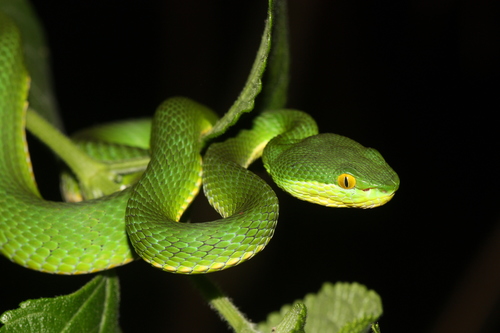
This species, Trimeresurus albolabris Gray, 1842, reaches a maximum total length of 600 mm (24 in) for males and 810 mm (32 in) for females. Maximum tail length is 120 mm (4.7 in) for males, and 130 mm (5.1 in) for females. For head scalation, there are 10–11 (occasionally 12) upper labials, and the first upper labial is partially or completely fused to the nasal scale. Head scales are small, roughly equal in size, weakly overlapping, and either smooth or weakly keeled. Supraocular scales are narrow, though they are occasionally enlarged and undivided, with 8–12 interocular scales lying between the two supraoculars. Temporal scales are smooth. Midbody has 29 (rarely 19) longitudinal dorsal scale rows. Ventral scales number 155–166 in males and 152–176 in females. Subcaudal scales are paired, numbering 60–72 in males and 49–66 in females. The hemipenes of this species lack spines. In terms of color pattern, the upper body is green. The side of the head below the eyes is yellow, white, or pale green, which is much lighter than the rest of the head. The belly is green, yellowish, or white. A light ventrolateral stripe is present in all males, but absent in all females. The tip of the tail is not mottled brown. This species is found in Nepal, Bhutan, Myanmar, Thailand, Cambodia, Laos, Vietnam, southern China (including Fujian, Hainan, Guangxi, Guangdong), Hong Kong, Macau, and Indonesia (including Sumatra, Java, Lombok, Sumbawa, Komodo, Flores, Sumba, Roti, Kisar, Wetar). Its given type locality is "China". This species is not present in India. Specimens previously recorded from India have recently been re-identified as Trimeresurus salazar, per Vogel et al. 2022. Specimens from the Nicobar islands have been described as a separate new species, Trimeresurus davidi.