About Trillium undulatum Willd.
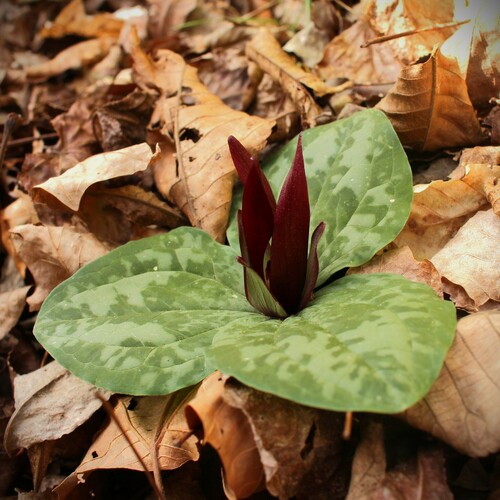
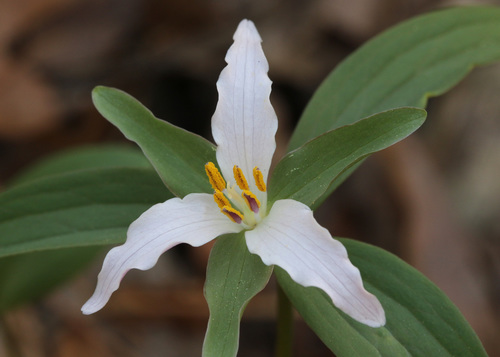
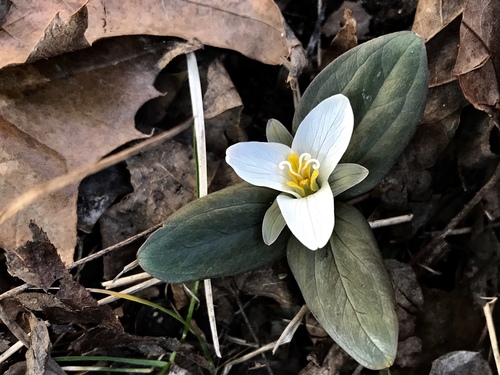
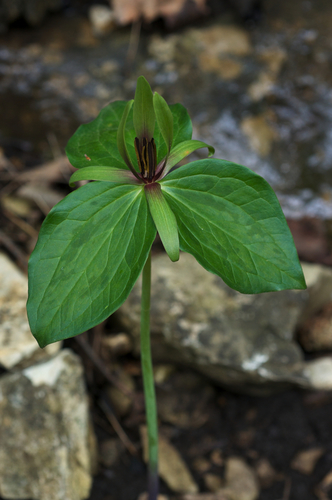
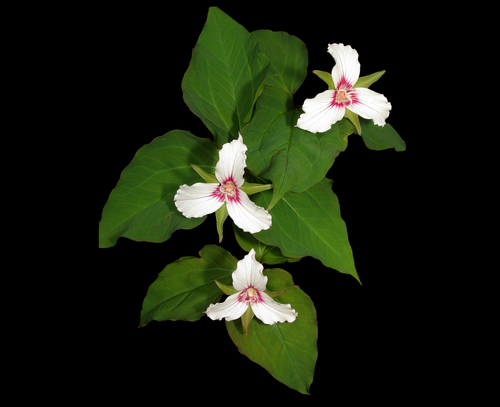
Trillium undulatum Willd. is a perennial herbaceous plant that spreads via an underground rhizome. Three large leaf-like bracts grow in a whorl around a scape (stem) that emerges directly from the rhizome. These bracts, commonly called leaves, are ovate, and each has a clearly defined petiole (leaf stalk). Flowering takes place from late April to the end of June. It produces a single, terminal, stalked (pedicellate) flower that has three sepals and three petals. The petals are white, have wavy edges, and bear a central red to reddish purple splotch at the base of the flower. If pollination is successful, a single fruit develops. The fruit starts green, and ripens to a bright red by mid to late summer. It is a berry-like capsule, 1 to 2 cm (0.5 to 1 in) long, with no ridges. No other North American Trillium species has a fruit matching this combination of size, color, and shape. Across its range, T. undulatum is one of twelve known pedicellate-flowered Trillium species, and it is also one of the easiest trilliums to identify. To start identification, check that each leaf has a distinct petiole at least 4 mm (0.2 in) long. Since other Trillium species sometimes have leaves with petioles, check the pedicel (flower stalk) to confirm. The pedicel of T. undulatum is short and erect. If the pedicel is longer than 5 cm (2.0 in) or not erect, the plant is not T. undulatum. Most Trillium species have an early one-leaf vegetative life stage, where the single leaf can be recognized by its color, texture, and venation when compared to the three leaves of a mature plant of the same species. T. undulatum populations often contain large numbers of single-leaf seedlings, because individuals stay in the one-leaf stage for relatively long periods of time. The range of Trillium undulatum stretches from Ontario in the north to northern Georgia in the south, and from Michigan in the west to Nova Scotia in the east. It has been recorded in the following Canadian provinces and US states: Canada: New Brunswick, Nova Scotia, Ontario, Prince Edward Island, Quebec; United States: Connecticut, Georgia, Kentucky, Maine, Maryland, Massachusetts, Michigan, New Hampshire, New Jersey, New York, North Carolina, Ohio, Pennsylvania, Rhode Island, South Carolina, Tennessee, Vermont, Virginia, West Virginia. T. undulatum requires strongly acidic, humus-rich soils, and typically grows in the shade of acid-loving trees including eastern white pine, red maple, red spruce, and balsam fir. While the soils that support this species have low base saturation, the foliage of T. undulatum has relatively high levels of calcium, magnesium, and especially potassium. As of October 2019, Trillium undulatum is globally secure. It is classified as vulnerable or a worse conservation status in at least seven U.S. states, and is specifically listed as endangered in both Ohio and Michigan.