About Trillium rugelii Rendle
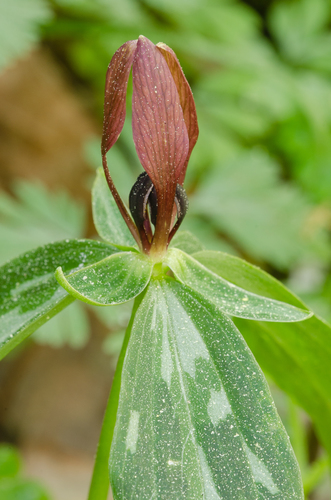
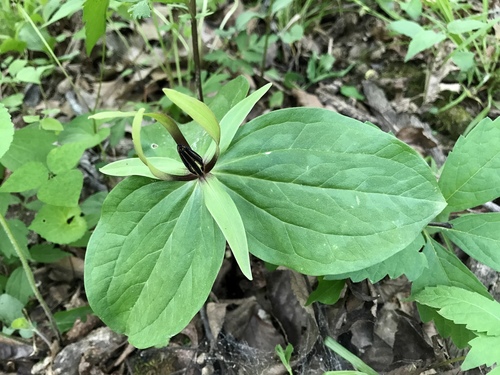
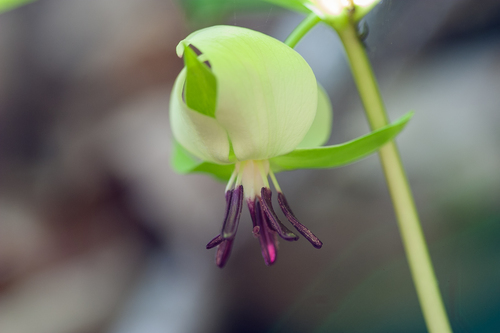
Trillium rugelii Rendle is a long-lived perennial herbaceous flowering plant that survives via an underground rhizome. Like all trilliums, it has a whorl of three leaf-like bracts, and a single trimerous flower that contains 3 sepals, 3 petals, two whorls of 3 stamens each, and 3 carpels fused into a single ovary with 3 stigmas. Its white flower sits on a short, strongly recurved pedicel that nods below the leaves. Its broad petals are recurved starting at the petal midpoint. The dark purple anthers are noticeably long, at least as long as the carpels, and sometimes extend past them. The ovary is flask-shaped. Trillium rugelii hybridizes with other Trillium species, particularly Trillium vaseyi. In these hybrids, the pedicel keeps the short, recurved trait of Trillium rugelii, while petals may be rose colored, dark rose-red, or bicolored from the influence of Trillium vaseyi. An unnamed form of Trillium rugelii found in central Alabama differs from the more typical form native to mountainous areas of Tennessee, North Carolina, South Carolina, and Georgia. The Alabama form has narrower petals that are strongly recurved starting from the petal base instead of the middle. It has white filaments rather than purple, and a mostly white ovary streaked with purple, instead of the completely dark purple ovary of the mountain form. Anther color and length are identical in both forms. The central Alabama plants are reported to produce strongly fragrant flowers that smell like old-fashioned garden roses. While floral fragrance is often stronger in southern populations of the species, it is overall variable. Despite reports of sweet fragrance, Trillium rugelii is sometimes called the ill-scented wakerobin. Trillium rugelii is endemic to the southeastern United States. It occurs in the Great Smoky Mountains, Fernbank Forest, Steven's Creek Heritage Preserve, and other locations across the Piedmont and southern Appalachian Mountains in Alabama, Georgia, South Carolina, North Carolina, and Tennessee. It prefers growing near streams in humus-rich soil in the shade of deciduous trees. This long-lived perennial herb blooms from mid April to May. If pollinated, a berry-like capsule matures in early to mid summer. The fruits do not appear to be adapted for long-distance seed dispersal, and most seeds likely fall close to the parent plant. Trillium species as a group are myrmecochorous, meaning ants help disperse their seeds. Trillium seeds have a white fleshy appendage called an elaiosome that attracts ants. Since every Trillium rugelii seed has an attached elaiosome, its seeds are probably also dispersed by ants.