About Trillium recurvatum L.C.Beck
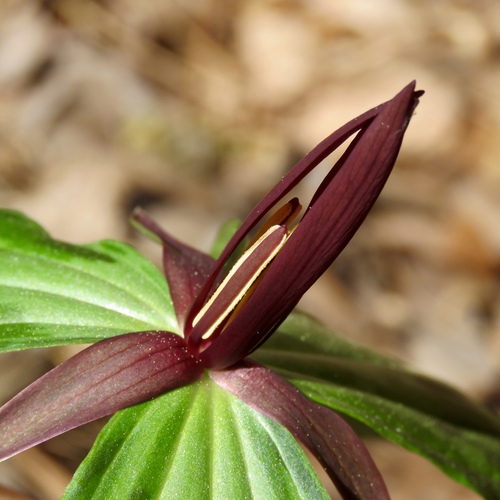
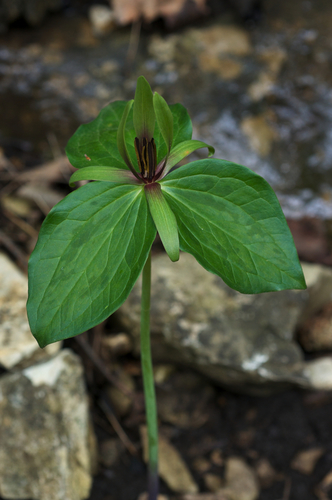
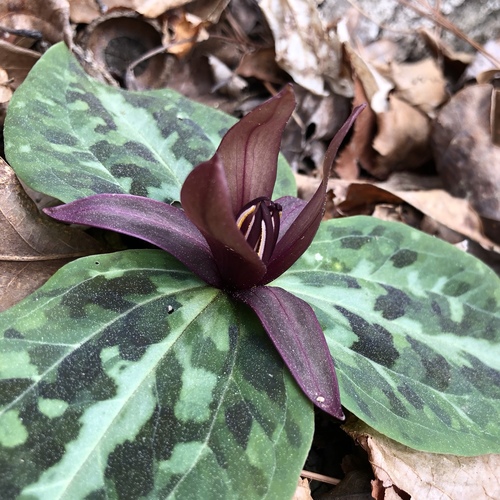
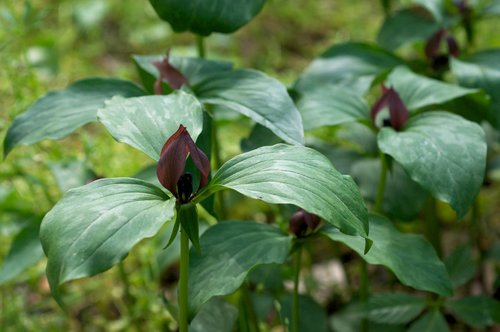
Trillium recurvatum L.C.Beck grows up to 40 cm (16 in) tall. It produces three ovate to lanceolate, mottled green bracts that are 6 to 18 cm (2 to 7 in) long, 2 to 6.5 cm (1 to 3 in) wide, and develop petioles when mature. This species grows both alone and in small clusters, and typically does not form large groups. Its flower has three brown to maroon petals that measure 1.8 to 4.8 cm (1 to 2 in) long and 0.9 to 2 cm (0 to 1 in) wide, with petal tips that arch over the stamens. The sepals are recurved, meaning they point downwards once the flower is fully open. The anthers are dark purple and grow up to 16 mm (1 in) long, and the stigma tips are also recurved. This combination of recurved sepals distinguishes Trillium recurvatum from other sessile-flowered Trillium species, such as Trillium sessile. The fruit is green, sometimes streaked with purple or white, and has six distinct, well-developed ridges. Its seeds have an oil-rich structure called an elaiosome, which encourages dispersal by ants and other foraging insects. The pollen of Trillium recurvatum is 15 to 26 micrometers in diameter, covered by a thin, bristly outer layer. Like pollen from other Trillium species, it is spherical, fragile, and contains internal channels. Trillium recurvatum pollen is most morphologically similar to pollen from Trillium lancifolium, with the two sharing many features, though their pollen diameter ranges differ slightly. As a spring ephemeral, Trillium recurvatum emerges in early spring and goes dormant by midsummer if it flowers, or by early summer if it does not flower. This means younger plants go dormant earlier than mature plants, which are typically around six to seven years old and can remain in flower throughout early summer. When pollinated, mature Trillium recurvatum produces berries shortly before entering dormancy. This species can reproduce both asexually through spreading rhizomatous growth, and sexually through insect pollination. Since Trillium recurvatum is self-incompatible, it depends on pollinators to deliver sufficient pollen for seed production; this reliance on pollinators is a greater barrier to successful sexual reproduction than limitations in other resources. When successfully pollinated, the plant produces a large number of seeds, but very few of these seeds grow into mature plants. Trillium recurvatum is native to the eastern and central United States. Its range is centered in Illinois and Indiana, but it occurs to some degree across at least sixteen states, extending from eastern Oklahoma to western North Carolina, north to central Wisconsin, and south to southeastern Texas. Throughout its range, it grows in deciduous forests, and especially favors moist, limestone-rich soil. Suitable habitats include ravines, floodplain forests, mesic forests, moist oak savannas (most commonly in Illinois and Indiana), and southern hardwood forests. In ecology, Trillium recurvatum acts as a host plant for Clepsis melaleucanus and Euplexia benesimilis. It is pollinated by insects including Collops and Coleomegilla maculata, and provides food for ants, small mammals, and deer. It is commonly found growing alongside other plant species that tolerate the same conditions, including the trees Platanus occidentalis, Acer nigrum, and Tilia americana, and the forbs Podophylum peltatum, Arisaema triphyllum, and Sanguinaria canadensis, among others.