About Trillium petiolatum Pursh
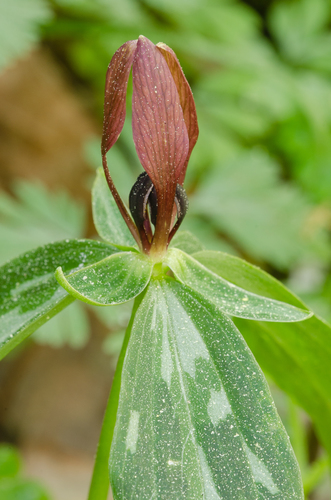
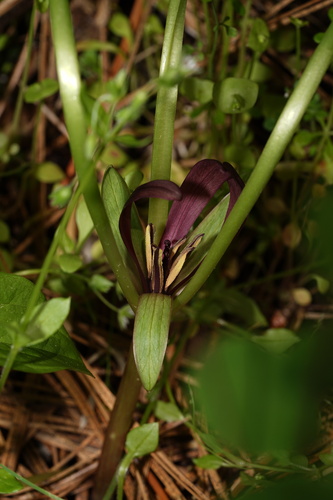
Trillium petiolatum Pursh is widely described as without question the least Trillium-like of all trilliums. Its specific epithet petiolatum, which means "petioled", was chosen to highlight its distinctive very long petioles, which measure 5 to 12 cm (2 to 5 in) in length. These petioles are nearly as long as the plant's leaf blades; each leaf blade is 7 to 14 cm (3 to 6 in) long and 5.5 to 10.2 cm (2 to 4 in) wide. The round-ovate leaf blades are solid green and not mottled. The petiolate leaves strongly resemble the leaves of common plantain. Frederick Traugott Pursh, who originally described the species, himself noted that T. petiolatum "has leaves very much like Plantago major."
The plant's scape measures 4 to 17 cm (2 to 7 in) long, but most of the scape stays below ground because the plant's rhizome grows deep underground, a trait thought to provide protection. As a result, the whorl of leaves and the sessile flower sit at or very near ground level. The flower is small: sepals range from 22 to 47 mm (0.87 to 1.85 in) long and 7 to 10 mm (0.28 to 0.39 in) wide, while petals range from 30 to 55 mm (1.2 to 2.2 in) long and 4 to 10 mm (0.16 to 0.39 in) wide. Petals are typically red, maroon, or purple, though yellow-flowered forms that lack purple pigments have been recorded.
Because of its small size and uncharacteristic leaf structure for a trillium, the plant is inconspicuous and easily overlooked. Trillium petiolatum shares similarities with both T. sessile and T. recurvatum. Among sessile trilliums, only T. recurvatum and T. petiolatum have petiolate leaves, but the two species have little else in common beyond this trait. Based on the structure of flower parts and reproductive organs, T. petiolatum appears to be more closely related to T. sessile.
Trillium petiolatum is native to mountainous areas of the northwestern United States, found in Idaho, Oregon, and Washington. It flowers from very early April to late May, with timing depending on growing conditions and elevation, and may bloom earlier on south-facing slopes. It grows at elevations ranging from 400 to 1,400 m (1,300 to 4,600 ft), in habitats above stream beds, under scrub brush, and near the edges of coniferous and deciduous forests. No other Trillium species survives in such harsh conditions. Only the habitat of Pseudotrillium rivale, a close relative of T. petiolatum, approaches T. petiolatum's habitat in terms of exposure, openness, and seasonal dryness.
Like T. ovatum, T. petiolatum does not grow well in eastern gardens. Like other Trillium species, T. petiolatum has a one-leaf vegetative growth stage, followed by a three-leaf vegetative juvenile stage. After several years of vegetative growth, the plant finally reaches its three-leaf reproductive flowering stage. It has an indefinite life span that can extend over many years.