About Trillium ovatum Pursh
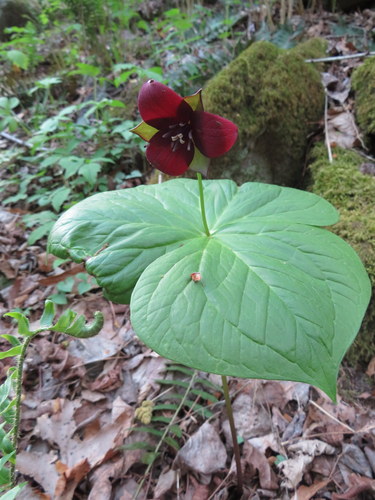
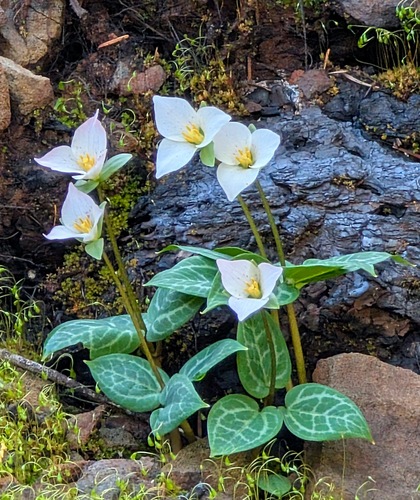
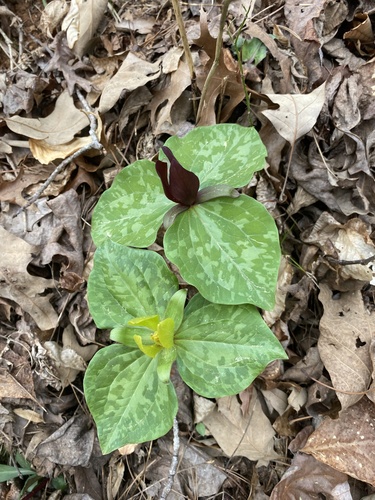
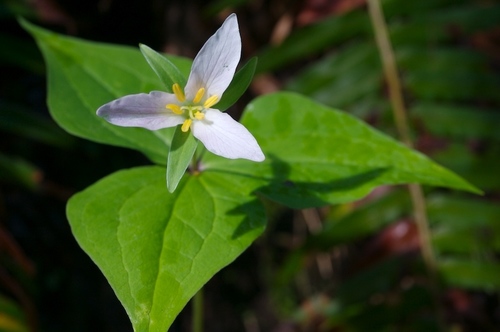
Trillium ovatum Pursh is the most widespread trillium species native to western North America, and it varies considerably across its range. Even with this variation, it closely resembles the eastern North American species Trillium grandiflorum, and the two are not easily distinguished based on characteristics other than geographic location. Trillium ovatum is a perennial herbaceous plant that spreads via underground rhizomes. At maturity, each individual produces one or two flowering stalks called scapes, each ranging from 20 to 50 cm (8 to 19.5 inches) in length. Its specific epithet 'ovatum', meaning 'egg-shaped', refers to its petals rather than its leaves. The leaves of T. ovatum are generally ovate-rhombic, measuring 7 to 12 cm (3 to 5 inches) long and 5 to 20 cm (2 to 8 inches) wide. Its flower is borne on a stalk called a pedicel 2 to 6 cm (1 to 2.5 inches) long. Sepals are 15 to 50 mm (0.59 to 1.97 inches) long and 6 to 20 mm (0.24 to 0.79 inches) wide, while petals are 15 to 70 mm (0.59 to 2.76 inches) long and 10 to 40 mm (0.39 to 1.57 inches) wide. Typically, the flower opens white and turns pink as it ages, but in the Smith River Canyon area of northern California and southern Oregon, the petals turn an almost barn-red. In the broad sense (sensu lato), Trillium ovatum is the most widespread and abundant trillium in western North America. Its range extends from Monterey County in central California northward through the California Coast Ranges to Vancouver Island and southwestern British Columbia. It also occurs in the Rocky Mountains, from southeastern British Columbia and the southernmost tip of southwestern Alberta south through Idaho, eastern Washington, and northeastern Oregon, and southeastward through western Montana. There is a small, isolated population in northern Colorado and southern Wyoming. It commonly grows in coniferous forests and mixed coniferous-deciduous forests, as well as in and around alder thickets and shrubs. Along the California coast, it is often found under coast redwood in mixed evergreen forest. At Lolo Pass, Montana, it grows under spruce and Douglas fir in ravines alongside mountain streams. It does not grow in the dry chaparral inland from the redwood and Douglas fir forests of California and Oregon, nor on ridges with sparse tree cover. Trillium ovatum var. oettingeri is endemic to a relatively small region in northwestern California. It occurs primarily in the Salmon Mountains, a subrange of the Klamath Mountains, in southwestern Siskiyou County, northern Trinity County, and northeastern Humboldt County. Smaller populations are found in the Cascade Range east of Mount Shasta, along the border between Siskiyou County and Shasta County. This variety grows at elevations between 4,000 and 6,300 feet (1,200 to 1,900 meters), often near cold mountain streams, on the banks of mountain lakes, or at the base of cliffs where late summer snow patches linger. The distribution of Trillium ovatum var. stenosepalum is reported inconsistently in scientific literature. After examining specimens from Montana, Idaho, Oregon, Washington, and California, Gates (1917) concluded that this taxon ranges from western Montana and southern Washington to middle California (Santa Cruz Mountains). More recently, Wayman et al. (2024) concluded that the taxon occurs in the Rocky Mountains of Idaho, Montana, Washington, and Colorado, while noting that additional field and laboratory work is necessary to confirm this. In the southern portion of T. ovatum's range, flowers bloom in late February; elsewhere, they bloom in March or April. Citizen science observations of flowering T. ovatum peak during the first week of April. By comparison, when T. grandiflorum is fully open in eastern North America, T. ovatum flowers are already fading in western North America. T. ovatum apparently does not have enough winter hardiness to flourish east of the continental divide. The life cycle of T. ovatum includes five stages: a cotyledon stage, a one-leaf vegetative stage, a three-leaf vegetative (juvenile) stage, a three-leaf reproductive (flowering) stage, and a three-leaf nonflowering regressive stage. The regressive stage involves a transition from the three-leaf flowering stage to a nonflowering three-leaf stage. Around one in four reproductive plants regresses to a nonflowering state each year. Under suitable conditions, individual plants may enter extended dormancy, meaning they stop producing above-ground growth for one or more years. In western Montana, dormancy was observed in all adult stage classes, with most plants returning to above-ground growth within one or two years, though some remained dormant for 3 to 5 years. Trillium ovatum is occasionally cultivated outside its native range, as far north as Sitka, Alaska. As a cultivated plant, it usually does not perform well, because it lacks the winter hardiness of other common garden plants.