About Trillium nivale Riddell
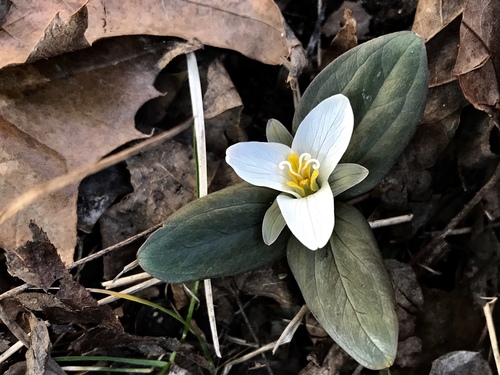
Trillium nivale, commonly known as snow trillium or dwarf white trillium, is a species of flowering plant in the family Melanthiaceae. It is native to parts of the eastern and midwestern United States, primarily the Great Lakes States, the Ohio Valley, and the Upper Mississippi Valley, reaching as far north as central Minnesota. It is a perennial herbaceous plant that flowers in late winter or early spring, and occasionally blooms when snow is still on the ground. Along the Ohio River valley, flowers can be seen in early March, while at its northern limit in Minnesota, it blooms in early April. Along with eastern skunk cabbage (Symplocarpus foetidus), T. nivale is one of the earliest flowering spring ephemerals. Despite its winter hardiness that would suggest its range could extend farther north, that is not the case. Soon after pollination, the pedicel turns downward, so that the mature fruit hangs below the leaves by the time it develops. In June, the plant sheds its seeds, and the entire above-ground portion of the plant suddenly disappears. Seeds are dispersed by ants, which may explain the low genetic diversity observed in some of its populations. Trillium nivale is smaller than many other species in its genus, seldom growing taller than 9 cm (3.5 in). Unlike most trilliums, it does not grow in leaf mold; instead it prefers limy sandy gravel, crevices in limestone, or calcareous mineral soil. Like other Trillium species, T. nivale goes through a one-leaf vegetative growth stage followed by a three-leaf vegetative (juvenile) stage. After at least twelve years of vegetative growth, the plant finally reaches its three-leaf reproductive (flowering) stage. In some populations, there can be ten or more one-leaf plants for every flowering plant. Flowering T. nivale have an indefinite multi-year life span, and often live for decades.