About Trillium kurabayashii J.D.Freeman
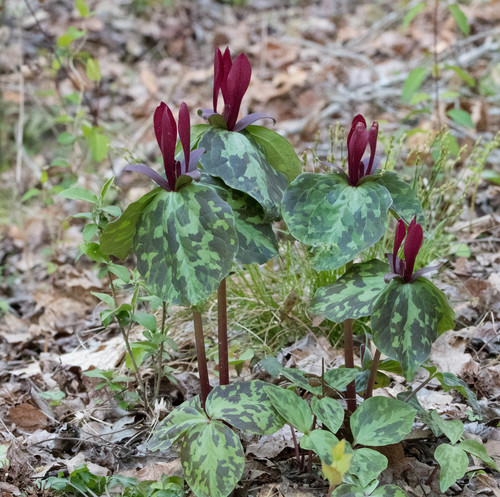
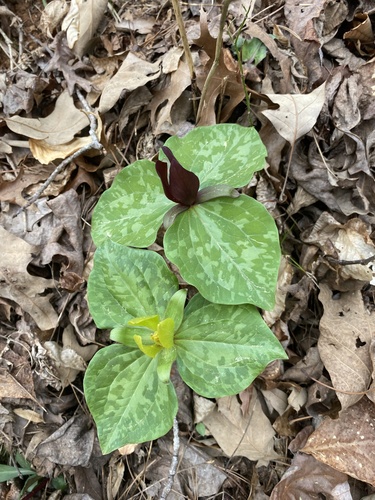
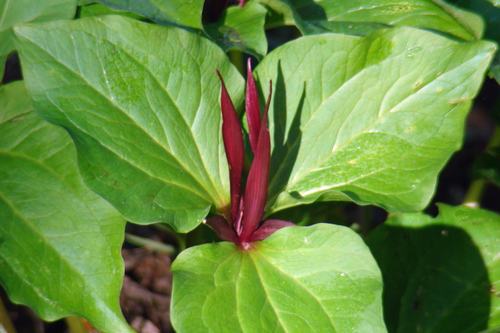
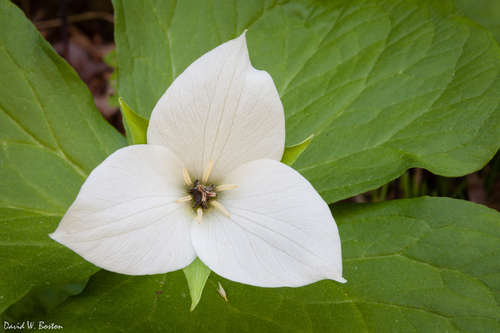
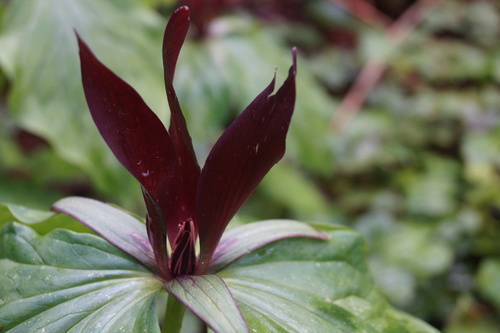
Trillium kurabayashii is a perennial herbaceous plant that survives via an underground rhizome. Like all trilliums, it has a whorl of three bracts (modified leaves) and one trimerous flower, with 3 sepals, 3 petals, two whorls of 3 stamens each, and 3 carpels fused into a single ovary topped with 3 stigmas. Because its flower has no stalk, it is a member of subgenus Sessilia, the group of sessile-flowered trilliums. Its scape is erect, measuring 28–44 cm (11–17 in) long, and is usually 2.3–2.5 times as long as its bracts. The bracts are sessile, ovate or widely ovate, 11–18 cm (4.3–7.1 in) long, dark green, and generally have slightly acuminate tips. Sepals are lanceolate, 42–70 mm (1.7–2.8 in) long, diverging, and greenish or purple at the base. Petals are oblanceolate, 65–105 mm (2.6–4.1 in) long, usually 3.3–4.6 times longer than they are wide, erect, and dark purple (variously described as maroon-red, red-purple, purple-red, or lurid purple); the underside of the petal is usually duller than the top. Stamens are erect, 16–25 mm (0.63–0.98 in) long, with short, dark purple filaments; anther sacs are introrse, 14–21 mm (0.55–0.83 in) long, and produce yellow pollen; connectives extend up to 0.5 mm. Carpels are approximately 4/5 as tall as or equal in height to the stamens; the ovary is ovoid, 9–13 mm (0.35–0.51 in) tall, dark purple, and shaped like a rounded hexagon in cross section; stigmas are coarsely subulate, 6–8 mm (0.24–0.31 in) long, erect, and dark purple. At anthesis, flowers have a spicy or musty odor, which sometimes becomes fetid as the flower ages. The fruit is dark reddish purple, ovoid to ellipsoid, weakly angled, 20–50 mm (0.79–1.97 in) long, and fleshy. Trillium kurabayashii has one of the largest flowers among all sessile-flowered trilliums, with recorded petals reaching up to 140 mm (5.5 in) long. There are two small disjunct populations of Trillium kurabayashii in the western United States. One population runs along the western slope of the Klamath Mountains from Curry County in extreme southwestern Oregon to Humboldt County in northwestern California. The type specimen was collected at the edge of a logged redwood forest in the town of Klamath, Del Norte County, California. The other population is found in the western foothills of the Sierra Nevada, in Placer, Nevada, Yuba, and Butte counties in northern California. Citizen scientists have observed T. kurabayashii in a small number of additional California and Oregon counties outside of its native range. The native range of Trillium kurabayashii overlaps with the ranges of T. angustipetalum and T. albidum. T. kurabayashii grows along streams at the edges of coastal redwood forests, in rich, moist conifer-hardwood forests, and at higher elevations in both forests and open grassy meadows with scattered oak trees. It occurs at elevations of 30–150 m (98–492 ft) along the coast, and 300–1,000 m (980–3,280 ft) in the Sierra Nevada. On the West Coast, Trillium kurabayashii flowers from late March to mid-April. Flowering occurs somewhat later in the Sierra Nevada, from early April to early May. It is winter-hardy in central Michigan gardens, but it emerges so early that it becomes damaged by frosts, so it never thrives in that region. A garden plant sold in nurseries as Trillium sessile var. rubrum was widely bought and traded during the 1950s and 1960s. It had sessile flowers with large, dark red, erect petals growing above strongly mottled, sessile leaves. The widespread availability of this plant was mostly due to the work of Gilman Keasey of Corvallis, Oregon, who grew large quantities of the plants from seed. By 1968, his annual crop of flowering-size plants reached about 15,000. Keasey collected his original three plants in northwestern California in 1947, which suggests the species was actually Trillium kurabayashii, the only species of sessile-flowered trillium currently known to occur in that region.