About Trillium grandiflorum (Michx.) Salisb.
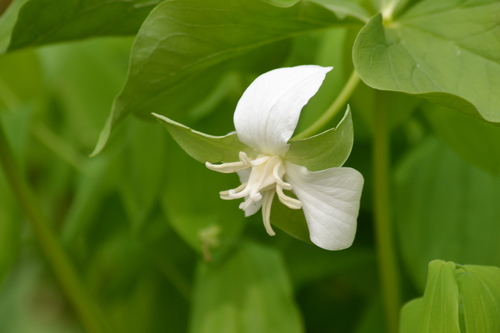
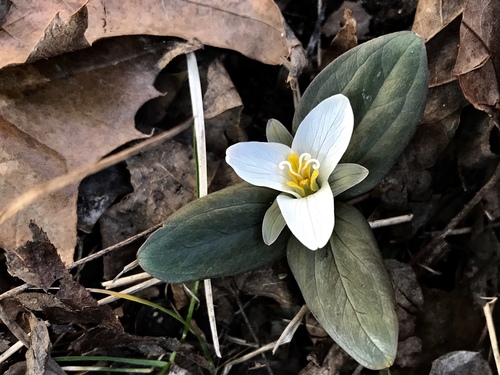
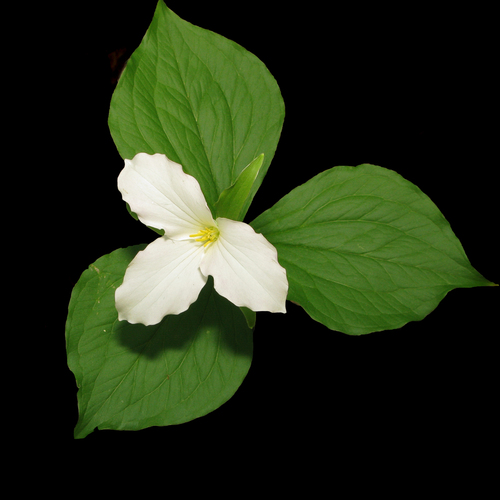
Trillium grandiflorum (Michx.) Salisb. is a perennial herb that grows from a short rhizome. It produces a single showy white flower held atop a whorl of three structures, which are often called bracts instead of leaves because the visible aboveground structure is technically considered a peduncle, and the actual main stem is the underground rhizome. A single rootstock often forms large, dense clonal colonies. Flowering stems reach 20–40 cm (8–16 in) tall. The erect, odorless flowers are large compared to other Trillium species, with petals 4 to 7 cm (1.5 to 3 in) long, where size depends on plant age and vigor. Petals resemble the leaf-like bracts in shape, curve outward, and have visible venation that is less prominent than venation on the bracts. Their overlapping bases and outward curve give the flower a distinctive funnel shape. Between the veined petals, three acuminate (long-pointed) sepals are visible. Sepals are usually a paler green than the bracts, and are sometimes streaked with maroon. The flower sits on a pedicel that raises it above the leaf whorl, and petals turn pinker as the flower ages. Flower reproductive parts include six stamens arranged in two whorls of three, which remain after fruiting. Anthers measure 9–27 mm (0.35–1.06 in) long, are pale yellow that becomes brighter when releasing pollen, and are much longer than the very short white styles. Stigmas are slender, mostly straight, narrow toward the tip, and the white petals are much longer than the green sepals. The ovary is six-sided, with three greenish-white stigmas that are weakly attached at their base and fuse together further up. The fruit is a green, moist, mealy roughly orb-shaped structure that is also vaguely six-sided, matching the ovary shape. Trillium grandiflorum grows best in well-drained, neutral to slightly acidic soils, most commonly in second- or young-growth forests. In the northern part of its range, it often grows in maple or beech forests, and can spread into nearby open areas. Flowering occurs from late April to early June, depending on geography, and typically happens just after Trillium erectum blooms. Like many forest perennials, T. grandiflorum is slow growing. Its seeds have double dormancy, meaning they normally take at least two full years to germinate. Seeds are dispersed in late summer, germinate after a cold period followed by a warm period to produce a root, and the seedling’s cotyledon only emerges after a second winter. Like most Trillium species, the age when a plant begins flowering depends mostly on leaf surface area and rhizome size, rather than chronological age alone. Due to slow natural growth, T. grandiflorum usually takes seven to ten years in optimal wild conditions to reach flowering size, which corresponds to a minimum of 36 cm² (5.6 sq in) of leaf surface area and 2.5 cm³ (0.15 cu in) of rhizome volume. A wide range of flowering ages is seen for plants grown in cultivation. Trillium grandiflorum was long thought to be self-pollinating, because pollinators were rarely observed visiting it and the species has low variation in chromosomal banding patterns. This conclusion has been strongly challenged by newer studies, which show high pollination rates by bumblebees and very low success for self-pollination in controlled experiments, indicating the species is actually self-incompatible. Many ovules on an individual plant often fail to develop into seeds. Pollen limitation is one contributing factor: one study found 56% of ovules produced seeds from open pollination, compared to 66% for hand-pollinated individuals. Plants with less exposure to pollinators were 33% to 50% less likely to produce fruit than plants with greater exposure, while hand-pollinated plants achieved 100% fruit set (though this did not mean 100% of ovules became seeds). Plant resource availability also limits seed production: when pollen is abundant, larger plants have a significantly higher seed-to-ovule ratio than smaller plants. The overall suboptimal seed-to-ovule ratios suggest T. grandiflorum has evolved to maximize reproductive success in highly unpredictable pollination environments, where some plants may only receive one pollinator visit per season. Ecologists have studied Trillium grandiflorum extensively for its unique traits. It is a well-known example of a plant whose seeds are dispersed through myrmecochory, or ant-mediated seed dispersal. This dispersal method effectively increases the plant’s ability to outcross, but does not move seeds very far. This pattern has led ecologists to question how T. grandiflorum and similar plants survived glaciation events during the ice ages. Additionally, plant height of T. grandiflorum can be used as an indicator of how intense deer foraging is in a given area. Fruits are released in summer, and contain an average of about 16 seeds each. Most seeds are dispersed by ants, though yellow jackets (Vespula vulgaris) and harvestmen (order Opiliones) have been observed dispersing seeds at lower rates. Insect dispersal is enabled by an elaiosome, a conspicuous oil-rich structure attached to the seed that is high in lipids and oleic acid. Oleic acid triggers corpse-carrying behavior in ants, so ants carry the seeds back to their nesting sites treating them as food. Because ants visit multiple plant colonies, they bring genetically distinct seeds to the same site, leading to new populations with relatively high genetic diversity, which ultimately increases biological fitness. While myrmecochory is the most common dispersal method, white-tailed deer occasionally disperse seeds after ingesting them and defecating the seeds. Ants only move seeds up to around 10 m (33 ft), but deer can transport seeds over 1 km (1,100 yd). This occasional long-distance dispersal explains how T. grandiflorum can colonize post-agricultural forest sites, and matches evidence of long-distance gene flow found in other studies. It also helps resolve what is called "Reid's paradox", which states that migration during glaciation events would have been impossible for plants with dispersal rates of less than several hundred meters per year, like T. grandiflorum. Occasional long-distance dispersal by deer likely helped this and other species with limited short-distance dispersal avoid extinction during ice age glaciations. Analysis of cpDNA haplotypes supports that T. grandiflorum survived the last glacial period in two glacial refuges in the southeastern United States, and long-distance dispersal allowed post-glacial recolonization of northern areas. In addition to lateral dispersal by invertebrates and deer, vertical burial of seeds by ants or other vectors improves new plant survival through two mechanisms. First, burial provides enough depth to protect seeds during their first year of dormancy. Second, burial gives adequate anchorage for young rhizomes, which are small with few short roots, making them easily dislodged by processes like frost heave and erosion and prone to desiccation. Trillium grandiflorum is one of the most popular trilliums in cultivation, primarily due to its large flowers and relative ease of growth compared to other species. While it is not particularly fussy about growing conditions, cultivation is slow and somewhat unpredictable because of its inherently slow growth, variable growth rates, and inconsistent germination rates. As a result, the vast majority of plants and rhizomes sold commercially are collected from the wild. Heavy wild collection combined with other threats such as habitat destruction and grazing has put some wild populations at risk, creating tension between Trillium enthusiasts and conservation advocates. Transplanting wild T. grandiflorum, like transplanting most non-weedy wild plants, is a delicate process that often results in the plant’s death. In cultivation, T. grandiflorum can flower as early as 4 to 5 years after germination, compared to the typical 7 to 10 years in the wild, but these early-flowering cases are exceptions rather than the rule. Once a plant begins flowering, it will continue to flower every year unless it is killed. It is winter hardy in USDA zones 4 through 8. A double-flowered cultivar, T. grandiflorum 'Pamela Copeland', was introduced to cultivation at the Mount Cuba Center, and named for Mrs. Pamela du Pont Copeland, the center's founder. This cultivar has received the Royal Horticultural Society's Award of Garden Merit. Some Native American groups cooked and ate the leaves of T. grandiflorum, and chewed the underground rootstalks for various medicinal uses.