About Trillium erectum L.
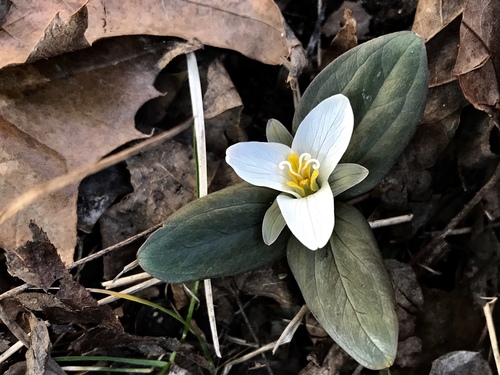
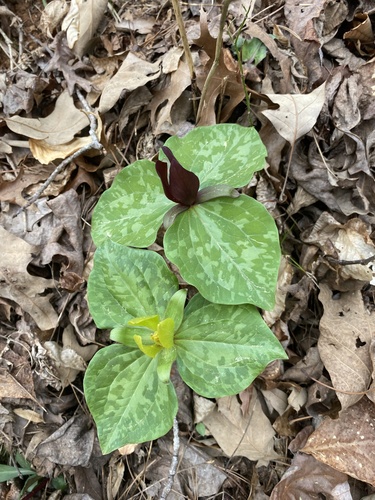
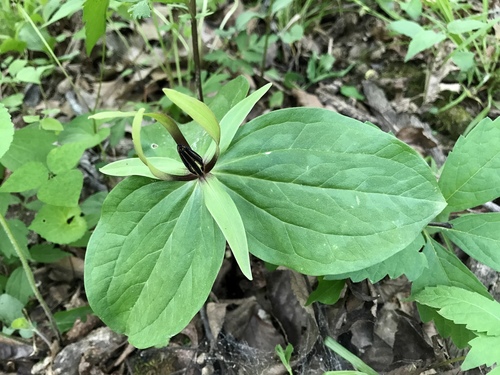
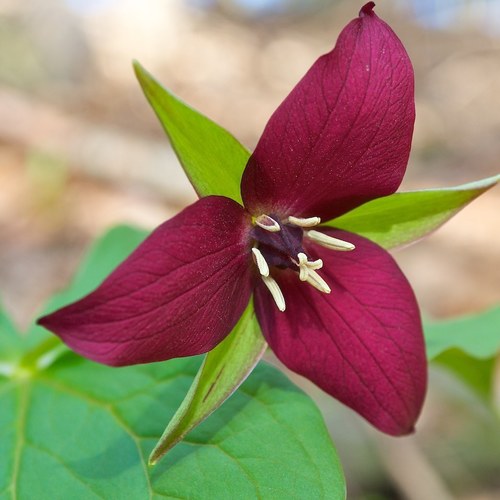
Trillium erectum L. is a perennial herbaceous flowering plant that survives via an underground rhizome. Like all trilliums, it has a whorl of three leaf-like bracts, and one single trimerous flower. This flower has three sepals, three petals, two whorls that each hold three stamens, and three carpels that fuse into one ovary with three stigmas. It reaches roughly 40 cm (16 in) in height and spreads to about 30 cm (12 in) across. Its petals can be dark reddish brown, maroon, purple, pale yellow, or white. Regardless of petal color, the ovary is always dark purple to maroon. If pollination succeeds, the petals wilt and a fruit develops, ripening into a dark red berry-like capsule 1–1.5 cm (0.39–0.59 in) long. This species is native to eastern North America. Its native range stretches from northern Georgia in the southeastern United States, north to Quebec and New Brunswick in eastern Canada, and west as far as Michigan and southern Ontario. It has been recorded in the following Canadian provinces and US states: Canada: New Brunswick, Nova Scotia, Ontario, Quebec; United States: Connecticut, Delaware, Georgia, Illinois, Indiana, Kentucky, Maine, Maryland, Massachusetts, Michigan, New Hampshire, New Jersey, New York, North Carolina, Ohio, Pennsylvania, Rhode Island, South Carolina, Tennessee, Vermont, Virginia, West Virginia. Trillium erectum var. album, as documented in the Flora of the Southeastern United States, grows in western North Carolina, eastern Tennessee, and other areas around the Great Smoky Mountains, mostly at elevations below 450 m (1,480 ft). As of October 2019, Trillium erectum is globally secure, but it is critically imperiled in Delaware, Illinois, and Rhode Island. Trillium erectum produces a carrion-like scent. It gives off foul, putrid odors thought to attract carrion flies and beetle pollinators. The foul odor is often compared to that of a wet dog. Its common name 'stinking benjamin' references this scented trait. The word 'Benjamin' in this common name is a corruption of 'benzoin', which itself is a corruption of 'benjoin', a plant-derived organic compound used in perfume production. Even with this origin for the common name, the chemical makeup of the plant's carrion-like scent is not well understood. It can tolerate extreme winter cold, and survives temperatures as low as −35 °C (−31 °F). Various indigenous peoples of North America used the root of this plant (also called red trillium) to aid childbirth, which gave it the common names birthwort or birthroot (sometimes corrupted to bethroot). Root tea was used to treat menstrual disorders, induce childbirth, and assist during labor. The Cherokee people made a poultice from the whole plant to treat tumors, inflammation, and ulcers. The plant's leaves contain calcium oxalate in the form of raphides, so they should not be consumed by humans. Trillium erectum is grown as a flowering ornamental plant. While it is not as showy as Trillium grandiflorum, the flowers of some Trillium erectum forms can be quite striking, particularly because the plant often forms large clumps. It has been awarded the Award of Garden Merit by the Royal Horticultural Society.