About Trillium cuneatum Raf.
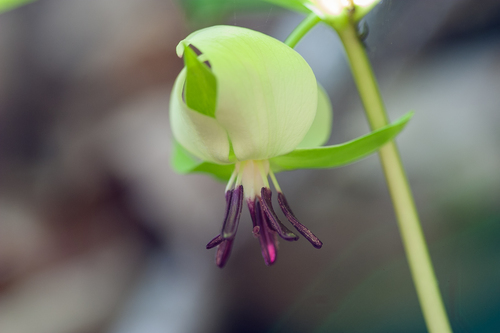
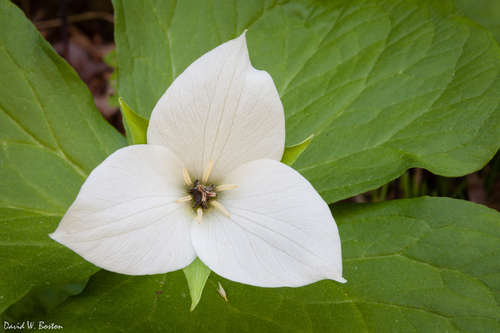
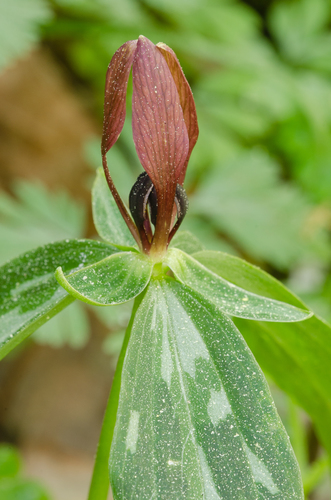
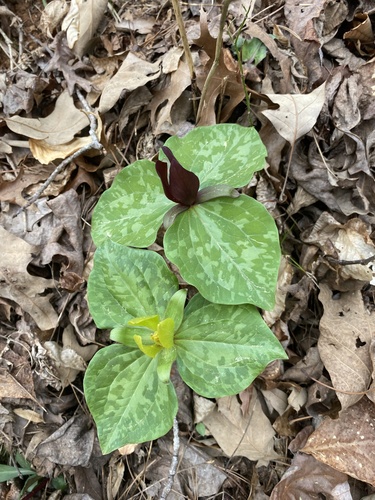
Trillium cuneatum Raf. is part of the Trillium cuneatum complex, alongside its closest relatives Trillium luteum and Trillium maculatum. This species is paraphyletic and morphologically variable. Some populations currently classified as T. cuneatum share a closer genetic relationship with T. maculatum than with other T. cuneatum populations. It may be split into multiple monophyletic species with greater morphological uniformity in the future. All members of this complex are sessile-flowered trilliums. Trillium cuneatum is a perennial herbaceous flowering plant that persists via an underground rhizome. Like all trilliums, it grows a whorl of three bracts commonly called leaves, and produces one single trimerous flower that has three sepals, three petals, two whorls of three stamens each, and three carpels fused into a single ovary with three stigmas. It bears a sessile flower with no flower stalk, erect petals, and mottled leaves. Its broad leaves surround a banana-scented flower, which can have maroon, bronze, green, or yellow petals. The species is well known for its morphological variation between, and even within, geographically distributed populations. Trillium cuneatum is endemic to the southeastern United States, where its range extends from Kentucky south to southern Mississippi, and east to the eastern coast of South Carolina. It is native to the states of Alabama, Georgia, Kentucky, Mississippi, North Carolina, South Carolina, and Tennessee. It has been widely introduced outside its native range, with established naturalized populations in Illinois, Maryland, Michigan, and Pennsylvania. Citizen scientists have recorded hundreds of observations of T. cuneatum outside its native range across more than a dozen U.S. states, with the most frequent observations coming from Virginia, Pennsylvania, Maryland, and New York. This trillium prefers growing in rich soils, most often in upland woods. It grows particularly well in limestone soils, but can also be found at less calcareous sites. Its known elevation range is 50–400 m (160–1,310 ft). In the southern portion of its range, from Mississippi to Georgia, Trillium cuneatum starts flowering in early March, with peak flowering around mid-March. In its northernmost populations, flowering takes place in April. Near Nashville, Tennessee, ripe fruits were observed to ripen and drop from the plant between July 1 and July 10. Most, if not all, Trillium species are myrmecochorous, meaning ants support their seed dispersal. Since every seed of T. cuneatum has an attached elaiosome, it is presumed that T. cuneatum seeds are also dispersed by ants.