About Trillium crassifolium Piper
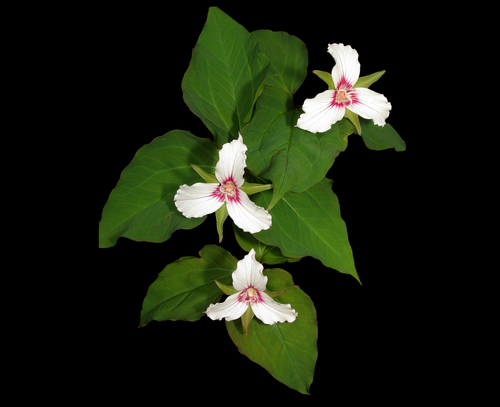
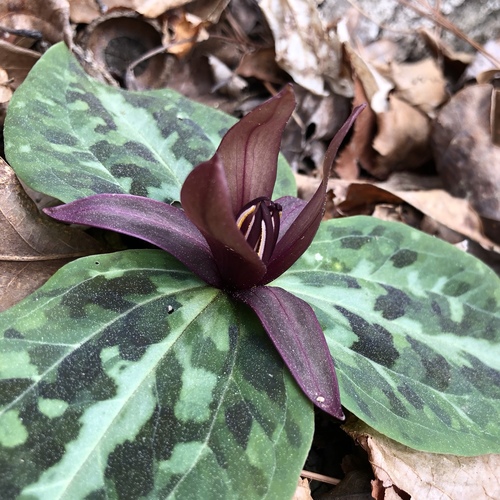
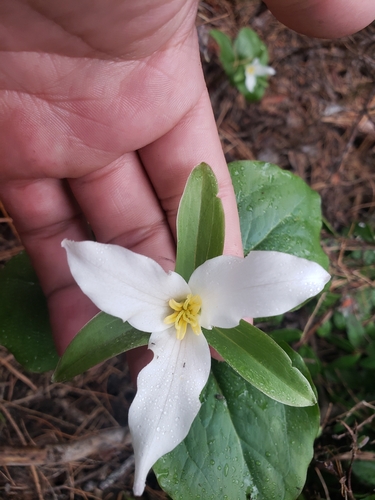
Trillium crassifolium Piper is a perennial herbaceous plant that survives using an underground rhizome. Like all trilliums, it grows a whorl of three bracts (leaves) and a single trimerous flower. This flower structure includes 3 sepals, 3 petals, two whorls that each contain 3 stamens, and 3 carpels fused into one ovary with 3 stigmas. Like other members of the Trillium ovatum complex, the flower of Trillium crassifolium is borne on a stalk, rather than being sessile (attached directly with no stalk). When the flower first opens for anthesis, its petals are white, and they fade to red or purple as the flower ages. It can be distinguished from Trillium ovatum by its erect rhizome, shorter petals, and thicker leaves. On average, the sepals and petals of Trillium crassifolium are roughly the same length, while the sepals of Trillium ovatum are far shorter than its petals. The leaves of mature Trillium crassifolium are elliptic in shape (not ovate or rhombic), with their widest point located near the middle of the leaf. Leaf tips range from obtuse to slightly acuminate. Trillium crassifolium has flattened filaments, which is a unique characteristic among pedicellate (stalked-flower) trilliums native to western North America. This species was first collected near Wenatchee, Washington, and was long thought to be endemic only to the Wenatchee Mountains. In 2024, it was reported to have a broader distribution across the Blue Mountains and Rocky Mountains of Oregon, Washington, and west-central Idaho. By the time this broader distribution was documented, the species was already commonly known as the Wenatchee Mountains Trillium.