About Trillium chloropetalum (Torr.) Howell
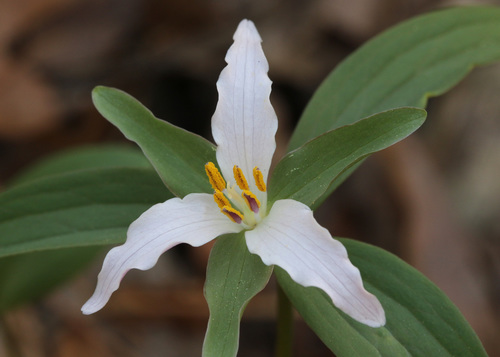
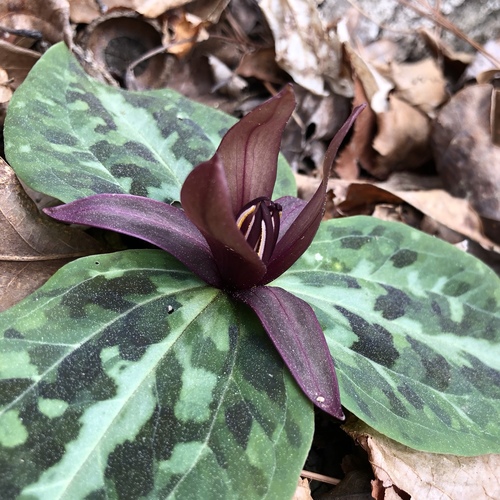
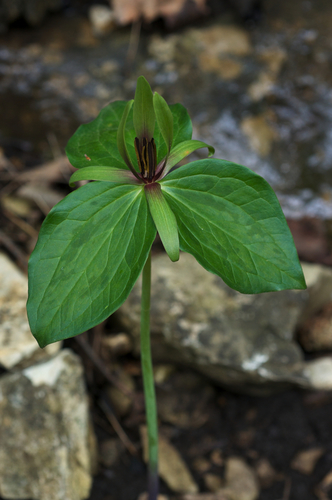
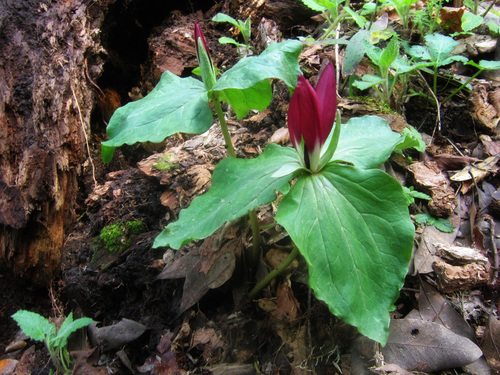
Trillium chloropetalum (Torr.) Howell is a perennial, clump-forming herbaceous plant that grows from a thick underground rhizome. Like all trilliums, it has a whorl of three bracts, commonly called leaves, and a single trimerous flower with 3 sepals, 3 petals, two whorls of 3 stamens each, and 3 carpels fused into a single ovary with 3 stigmas. Because its flower has no stalk, T. chloropetalum is a member of subgenus Sessilia, the group of sessile-flowered trilliums. It is one of the largest known Trillium species, with a scape, or stem, measuring 20 to 70 cm (7.9 to 27.6 in) in length. Its bracts are broadly ovate, 7 to 21 cm (2.8 to 8.3 in) long and 7 to 18 cm (2.8 to 7.1 in) wide. Bracts are usually marked with brownish mottling, though they are sometimes unmottled. Petal color in this species is highly variable, typically ranging from pale greenish yellow to greenish bronze, alternatively purplish green, to dark purple. A variety lacking yellow pigments has petal colors ranging from white to reddish-purple. The flower petals enclose purple stamens that are 15 to 30 mm (0.59 to 1.18 in) long, along with a purple ovary. Flowering occurs from late February to early April. In the San Francisco Bay Area, a white-petaled form of T. chloropetalum is often confused with T. albidum, another white-petaled trillium. T. chloropetalum can be distinguished by the purple pigment in its anther connective tissue, a trait that is not present in T. albidum. Trillium chloropetalum is endemic to California. Some authorities state the species occurs across ten California counties, extending from Monterey County on the central California coast north to Lake County in the state’s north central region: the counties are Alameda, Contra Costa, Lake, Marin, Monterey, Napa, San Mateo, Santa Clara, Santa Cruz, and Sonoma. Other authorities hold that T. chloropetalum has a broader range that extends north as far as Siskiyou County or south as far as Santa Barbara County. T. chloropetalum grows at the edges of redwood forests and chaparral, most often on moist slopes, canyon banks, and alluvial soils. The variety Trillium chloropetalum var. giganteum, which has deep maroon flower petals, was awarded the Award of Garden Merit (AGM) by the Royal Horticultural Society in 1993.