About Trillium cernuum L.
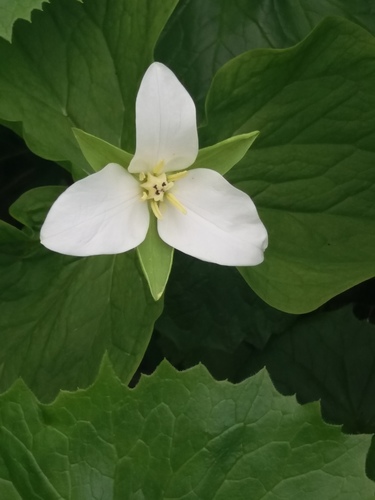
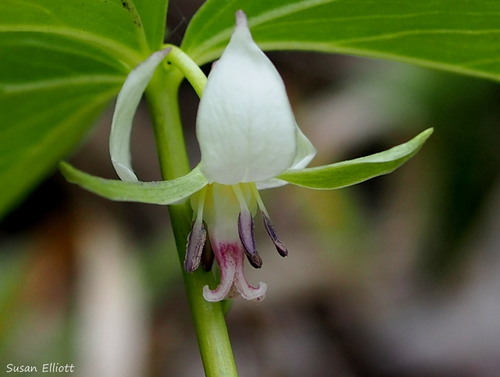
Trillium cernuum L. is a perennial herbaceous plant that spreads via an underground rhizome. Up to three scapes (stems) grow directly from the rhizome, each reaching 15–40 cm (6–16 in) tall. The apex of each scape bears a whorl of three leaf-like bracts, each measuring 5–15 cm (2.0–5.9 in) long and 6–15 cm (2.4–5.9 in) wide. Flowering takes place from late April to early June, and may occur as late as July in the northern portion of the species' range. A single flower hangs below the bracts from a short recurved pedicel that is 1.5–3 cm (0.6–1.2 in) long. The flower has three slender pale green sepals, each 9–30 mm (0.4–1.2 in) long, and three strongly recurved white petals, which are rarely pink. Each petal measures 15–25 mm (0.6–1.0 in) long and 5–15 mm (0.2–0.6 in) wide. This bisexual flower has six stamens and a single pyramidal white or pink ovary. Each stamen is made up of a thin white filament and a pale lavender-pink or gray anther, and the filaments and anthers are approximately the same length. A single fruit develops after successful pollination. The fruit is white or pink when immature, and ripens to dark red by late summer. When fully ripe, it is a plump six-lobed berry that can grow up to 3 cm (1.2 in) in diameter. Historically, Trillium cernuum has been confused with several nodding Trillium species native to the southern Appalachian Mountains. Within its natural range, T. cernuum is often confused with two sympatric Trillium species: T. erectum and T. flexipes. Accurate identification usually requires a mature, flowering plant, as the three species are very hard to tell apart when not in flower. Furthermore, all three species are known to interbreed, which adds to identification confusion. To distinguish T. cernuum from T. erectum and T. flexipes, begin by examining the pedicel. If the pedicel is longer than 3 cm (1.2 in), the plant is not T. cernuum. More importantly, the pedicel of T. cernuum is strongly recurved below the leaves, a trait the other two species rarely have. Northern forms of T. flexipes often have recurved pedicels and/or recurved petals. These forms closely resemble large T. cernuum plants, so the two are frequently confused. In these cases, examine the stamens. T. cernuum has slender lavender-pink or purplish anthers, with anthers and filaments of approximately equal length. By contrast, T. flexipes has thick creamy white or yellow anthers, where the anthers are much longer than the typically very short filaments. The range of Trillium cernuum spans Canada from Saskatchewan in the west to Newfoundland in the east, and extends south as far as northern Virginia in the mid-Atlantic United States. It has been recorded in the following provinces, states, and territories: Canada: Manitoba, New Brunswick, Newfoundland and Labrador, Nova Scotia, Ontario, Prince Edward Island, Quebec, Saskatchewan; United States: Connecticut, Delaware, District of Columbia, Illinois, Indiana, Iowa, Maine, Maryland, Massachusetts, Michigan, Minnesota, New Hampshire, New Jersey, New York, North Dakota, Ohio, Pennsylvania, Rhode Island, South Dakota, Vermont, Virginia, West Virginia, Wisconsin; and Saint Pierre and Miquelon. At the southern end of its range, T. cernuum grows in rich, cool, moist to swampy deciduous woods, along shrubby stream banks, and at pond edges within deep forests. In Michigan, it also grows along streams and in swamps, but within conifer-hardwood forests. In its northern range, it occurs in drier (though still moist) upland deciduous-coniferous woods. As of October 2019, T. cernuum is globally secure. It is classified as vulnerable or worse in at least a dozen states and provinces. It is specifically critically imperiled in Illinois, Indiana, and West Virginia. A single specimen was collected in Lake County, Ohio in 1879, and the species is now thought to be extirpated from Ohio.